

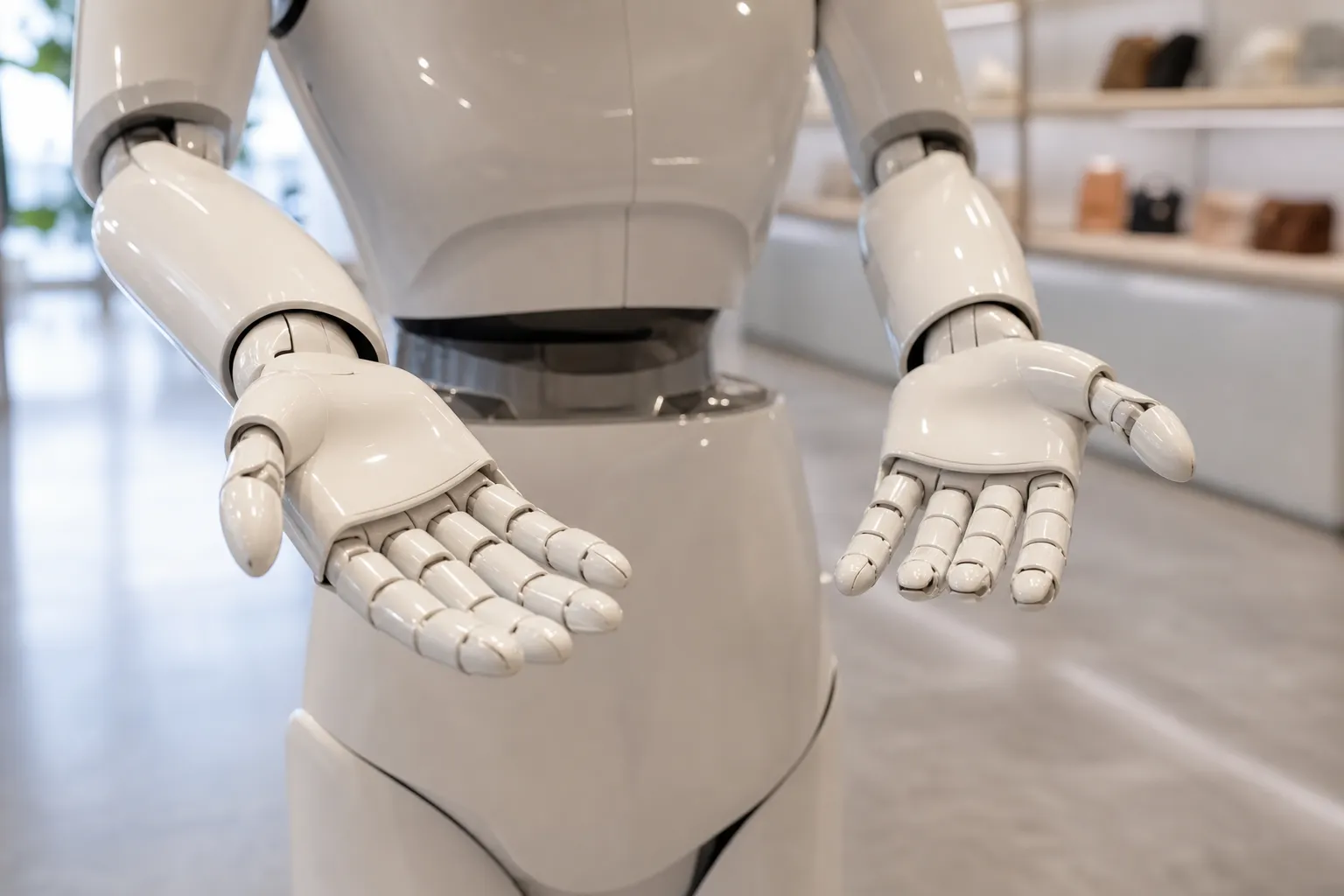
Presented on 29 October in Beijing, Bubbo 1 is a companion robot for families, sold in China for 9,499 yuan. It combines recognition of household members, emotional interaction and animated facial expressions.
Developed by Xinyan Robotics, a Chinese company founded in 2025, Bubbo 1 was introduced at an event dedicated to new products and to the relationship between technology and the humanities. Its chief designer, Ren Yongliang, is betting on a robot that can keep children, adults and older people company, tailoring its interactions to each user.
Bubbo 1 specs: 26 sensors and two expressive screens
Bubbo 1 runs on Bubbo OS, an operating system developed in-house to manage interactions between the robot and household members. Its architecture is built around the Family Agent concept: an artificial intelligence that recognizes the different people in a family, takes their relationships into account and adapts its behavior to their needs.
According to Xinyan Robotics, the robot has 26 sensors across 13 categories. The manufacturer presents it as the embodied home agent with the largest number of sensors. This claim is part of its marketing.
Bubbo 1 also has 6 degrees of freedom and two screens that display facial expressions. The manufacturer says it can understand complex emotions.
During the Beijing presentation, a demonstration reported by Chinese outlet Dianchang showed the robot responding to touch on its head or face. During voice exchanges, its facial expressions changed in line with its answers. The demonstration gave a concrete view of how it interacts.
How Bubbo 1’s AI adapts conversations for children and adults
Bubbo 1’s conversational system is bilingual by default. It also uses a tiered dialogue mechanism to match the complexity of its answers to how much the person it is talking to can understand.
Xinyan Robotics describes three design principles: building delays into responses, reproducing a breathing rhythm in conversations and maintaining relational boundaries. The stated goal is to make conversations more natural while reducing the risk of emotional dependence on the robot.
Ren Yongliang also presents Bubbo as a potential smart family photographer, designed to capture shared moments and make it easier to take photos with every member of the household in the frame.
A smart ring to track emotional changes
Alongside the robot, the Cece team presented a smart ring designed to work with Bubbo 1. According to the announced features, the accessory can share data with the robot and continuously track its wearer’s emotional changes.
Pairing the two devices is meant to enrich interactions by taking into account the information collected by the ring. It is part of Xinyan Robotics’ strategy, which focuses on emotional companionship technology for the home.
How much does Bubbo 1 cost? 9,499 yuan, with a launch offer
The first mass-produced Bubbo came off the production line in mid-August 2026. On 29 October 2026, Xinyan Robotics announced that it was going on sale on the Chinese platform JD.com and other official channels.
The list price of Bubbo 1 is 9,499 yuan. A launch offer gives the first 1,000 buyers a reduced price of 7,999 yuan.
To explain this pricing, Ren Yongliang compared the robot with bilingual family companion services, whose monthly salary he puts at around 10,000 yuan, based on information published on Chinese social media.
He argues that spreading the robot’s purchase price over several months would come to less than 1,000 yuan a month and, assuming five hours of use a day, no more than about 10 yuan an hour. These figures are part of his sales pitch, not a measurement of the actual cost of use.
Who makes Bubbo 1: technology rooted in Cece’s emotional support work
In 2011, Ren Yongliang founded Beijing Lituo Feiyuan Technology, also known as the Cece group. In 2013, he launched the Cece app, dedicated to emotional companionship and online psychological support.
The group’s artificial intelligence work then progressed with a first question-answering model in 2019, the integration of large language models in 2023 and the launch of the Xin Yuan model in 2024. That same year, the Cece group was renamed Xinyan Group.
With Bubbo 1, this experience in conversational and emotional services takes the form of a physical device designed to interact directly with family members, now on sale in the Chinese market.