

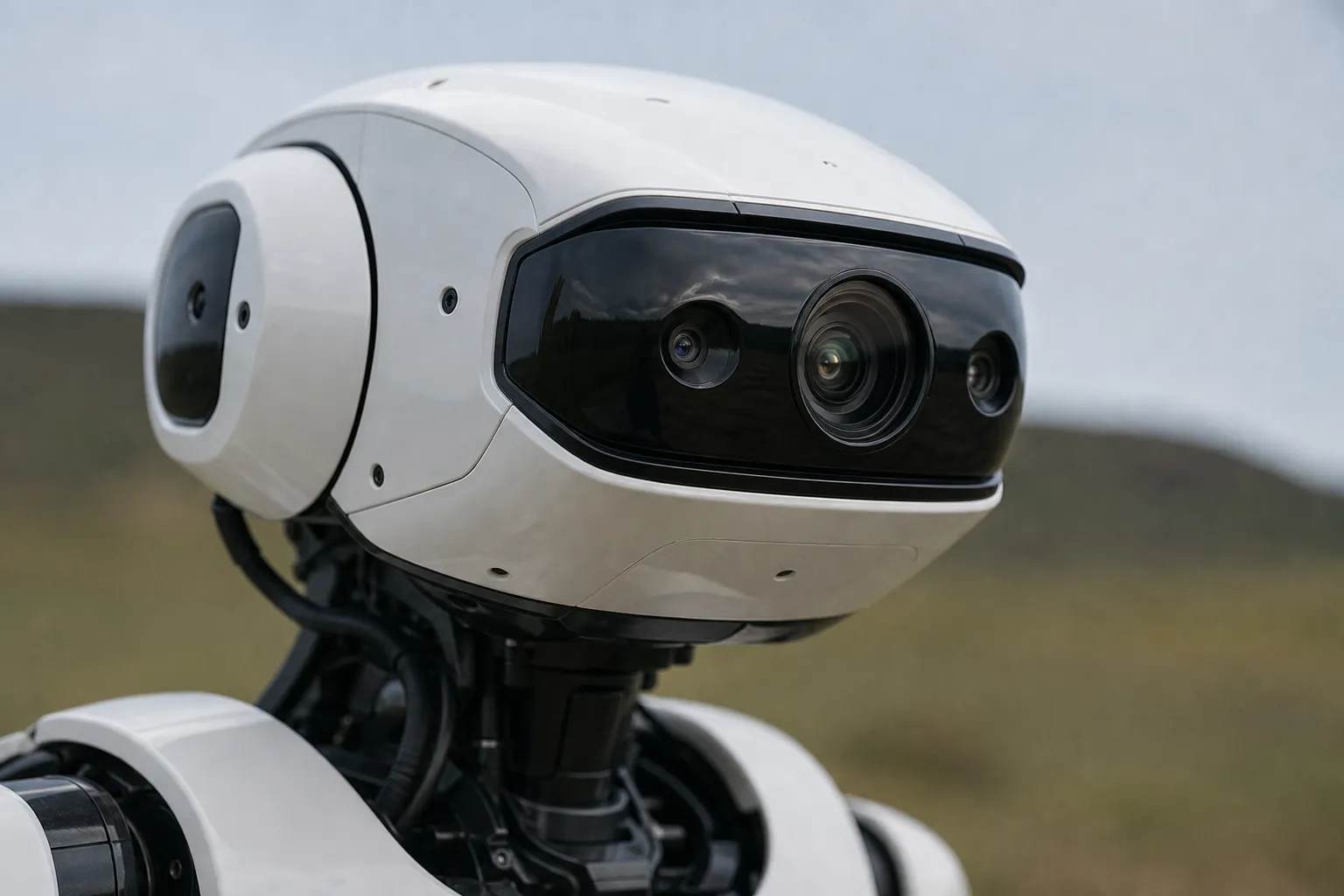
Alibaba and its subsidiary Amap have presented λ0, an artificial intelligence model that trains humanoid robots using human movements. According to the results they have released, this approach speeds up data collection and improves task success on real robots.
Developed jointly by Amap and Alibaba’s ATH business group, λ0 is built on a method for learning whole-body movements. The goal is to transfer human gestures that combine locomotion, posture and two-handed manipulation to robots, without relying solely on demonstrations recorded directly on the machines. The approach is aimed in particular at tasks that require a sequence of movements and manipulations in warehouses, shops and homes.
How collecting human motion cuts robot training time
Traditional robot data collection relies largely on teleoperating physical machines. It requires specialised equipment, and people have to step in to reset the training scenarios.
With λ0, Amap favours data collected directly by people wearing consumer devices. Their movements are recorded in everyday settings and then processed for use in robot training.
According to measurements presented by Amap on representative tasks, the time needed to collect one demonstration drops from about 100 seconds with robot-based collection to 29 seconds with the human method. The company therefore claims data collection that is about 3.4 times more efficient.
The method is designed to make it easier to scale up training data without a proportional increase in teleoperation on physical robots.
HumanVerse-500: a 500-hour dataset of whole-body human motion
To train λ0, Amap built HumanVerse-500, a dataset containing 500 hours of recordings of whole-body human movement in open environments.
The system combines visual information, body movements and hand movements. Training then proceeds in three stages: hand interactions, whole-body coordination and adaptation to the humanoid form.
This structure addresses a weakness of vision-language-action (VLA) models trained mainly on local interactions. Data centred on arms and hands does not always capture the simultaneous movements of the torso, the joints and the rest of the body.
λ0 also includes mechanisms that align human and robot viewpoints and movements. These are used to adapt demonstrations to differences in body structure and to the constraints of robot controllers, particularly during physical contact with objects.
Real-robot tests: a 22.5% higher task success rate
The evaluations presented by Amap include the SIMPLE simulation benchmark and several trials on physical robots. The company claims leading performance in these evaluations.
Amap reports a 22.5% improvement in task success rate on real robots compared with the best-performing baseline method used in its comparison.
The researchers also report zero-shot transfer, meaning no additional task-specific training, on real robots for 7 tasks combining whole-body coordination and long-distance movement. These results rely on the use of human motion data.
The experiments also indicate that, with the same number of robot demonstrations, increasing the volume of whole-body human data improves performance on tasks carried out by physical robots.
What Alibaba is releasing to developers
The collaboration between Amap and Alibaba’s ATH group covers the collection of human movements, their adaptation to humanoid robots and the evaluation of capabilities on physical machines.
The planned applications include logistics and inspection, where robots must coordinate movement, posture changes and manipulation in varied environments.
Amap has published the project’s hardware configuration code on GitHub. Samples from the HumanVerse-500 dataset are also available on Hugging Face, so that developers and research teams can experiment with this method of learning from human movement.