

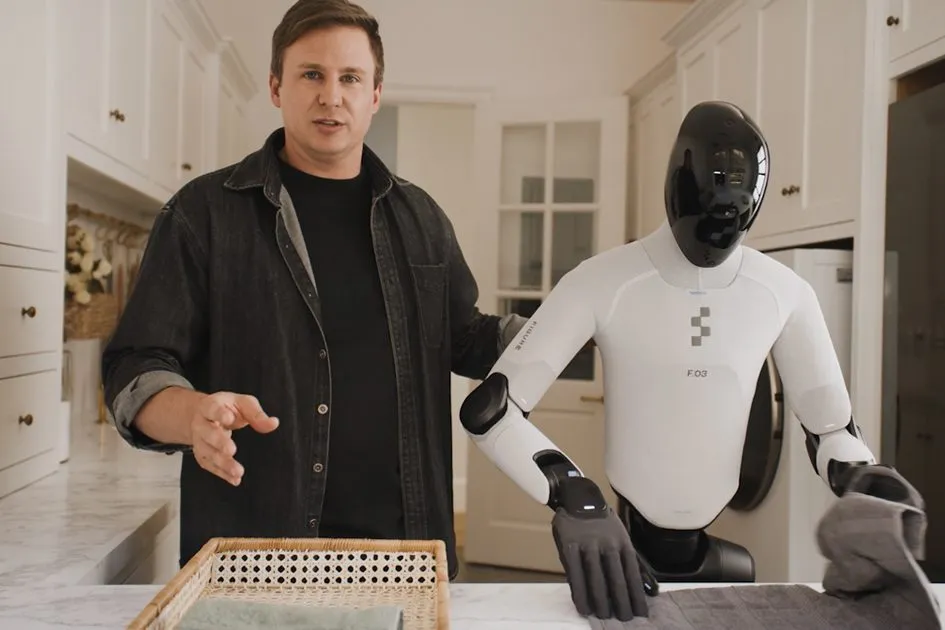
Can a humanoid robot walk into a house it has never seen and get to work straight away, without any data collected on site? That is the question Figure is asking with Helix 2.5, which the company describes as its most advanced neural network. Figure says it tested the model in 30 homes in the Bay Area, California, on three tasks, with no local fine-tuning.
Figure calls the exercise zero-shot: the model had never seen the evaluation environments or the objects it handled during training. The tasks themselves had been defined using data collected elsewhere. In each home, the robot worked with the sofas, beds and surfaces already there, using objects that had been set aside before testing began. According to Figure, an AI model followed by a human review confirmed that these objects did not appear in the training data.
Which household tasks Helix 2.5 was tested on
The three behaviours evaluated were tidying a living room, folding towels and making a bed. Figure lists the success criteria, which were set before the evaluation:
- Living room tidying: all 13 to 15 scattered toys are picked up and placed in the basket.
- Towel folding: all towels are folded and placed in the basket.
- Bed making: both pillows and the corners of the duvet are placed at the head of the bed, and the duvet is smoothed out.
The company says it gave no partial credit: a task only counts as a success if it is completed in full. Each task used the same frozen checkpoint across all 30 homes, with no adjustment of the weights to the environments or the evaluation objects.
According to Figure, all three behaviours come from a single foundation model, pre-trained on Index, a large-scale dataset of human behaviour. They involve locomotion, manipulation of rigid and deformable objects, two-arm coordination and active perception.
Helix 2.5 success rate: from 9% to 56%, according to Figure
To measure what pre-training actually contributes, Figure says it trained two policies on identical task specification data, which included neither the evaluation homes nor the evaluation objects. One started from random weights, the other from the Helix 2.5 model pre-trained on Index. Architecture, optimisation and evaluation were kept identical.
The reported result: in blind evaluation, the policy trained from scratch succeeded in 9% of zero-shot trials, compared with 56% for the policy pre-trained on Index, more than six times higher. Figure concludes that pre-training on Index accounts for most of the model’s zero-shot capability. The company adds that no evaluation task makes up more than 1.90% of the pre-training dataset.
Figure also says it compared Helix 2.5 with an earlier version, Helix 02, which was trained directly in the environment where it was evaluated. According to the company, Helix 2.5 reached the same success rate with half as much adaptation data, while also generalising to 30 unfamiliar homes.
Self-correction and scaling law in Helix 2.5
Figure highlights an improvement it considers significant: the robot’s ability to correct itself. That includes stepping back to reposition, changing posture, or walking around a bed to resume folding. The company attributes this recovery ability to pre-training on Index.
Figure also points to a scaling law for human-to-robot transfer. It says it trained four models on subsets of Index spanning an eightfold increase in data volume, with model size and downstream training held constant. Prediction loss fell steadily with each doubling of data, consistently enough that the largest experiment was, according to Figure, predictable to four decimal places before training even began.
Figure stresses that it does not claim general-purpose humanoid robotics has been solved. For the company, this is a demonstration of zero-shot whole-body generalisation on a humanoid, which it presents as the first at this scale.
Further reading: Helix, Figure’s AI: how it works and how it was tested · Figure AI: humanoid robots, Helix AI and the BotQ factory