

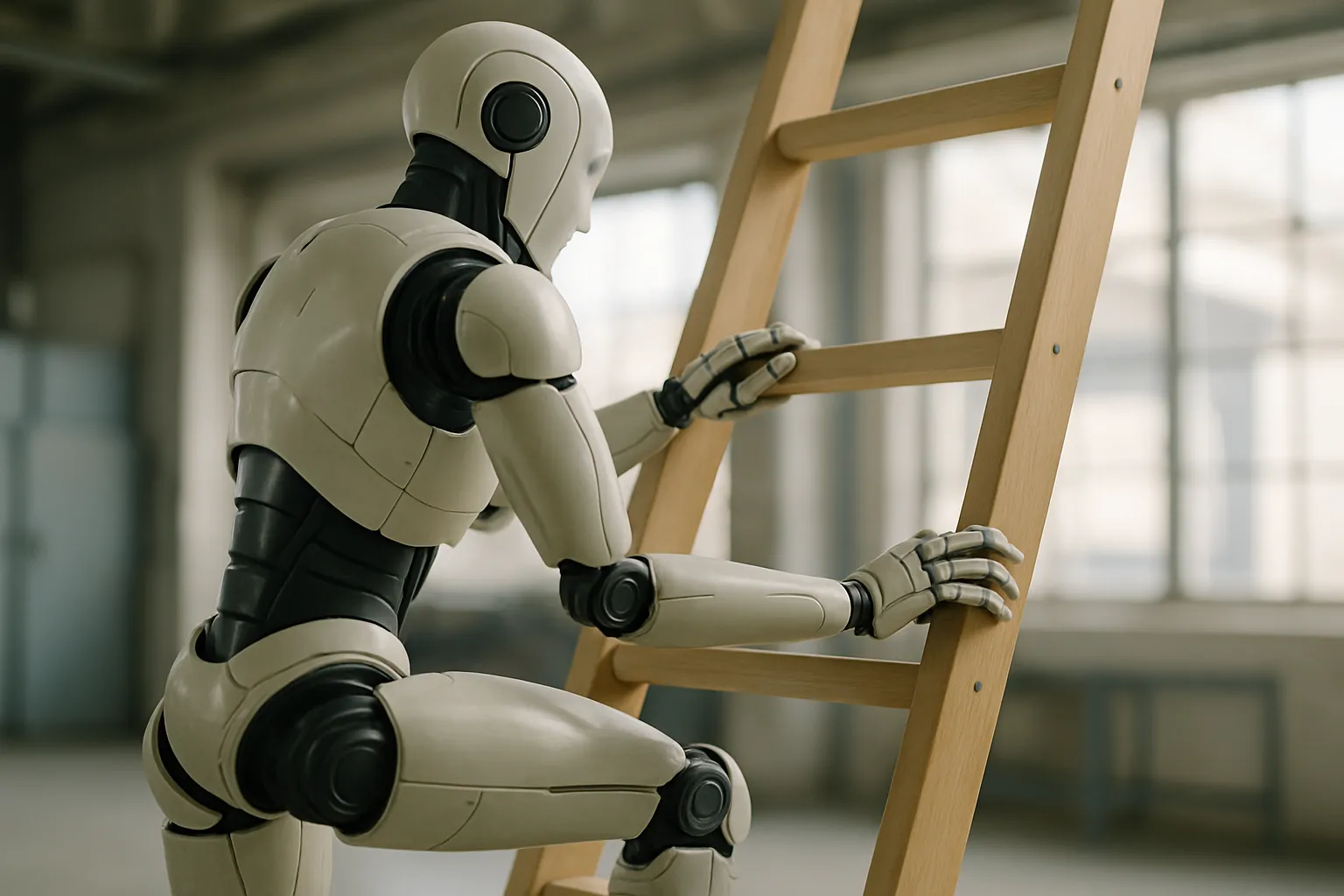
Figure AI has posted a video on X showing a Figure 03 humanoid robot climbing what looks like a ship’s ladder, meaning a steep staircase with a fixed handrail. The clip was shared by Brett Adcock, founder of Figure AI, who writes that the F.03 can now climb a ladder fully autonomously, with no remote human control.
In the video, the robot climbs three steps to reach a platform. It does not move in a smooth, alternating rhythm. It repeatedly scans its surroundings, looks for places to grip with its hands, then slowly pulls itself up. The success rate for the task is not given.
Why ladder climbing is one of the hardest mobility tasks for humanoid robots
Climbing a ladder is seen as one of the most demanding tests of motion control for humanoid robots. It requires accurate perception of the surroundings, decisions based on that perception, precise coordination of the limbs and torso, and responsive real-time balancing. Here, though, the task is easier than on a ladder set at a steeper angle, since the structure being climbed is a staircase with a fixed handrail.
How does Figure 03 climb? What the video does not reveal
Adcock gives no details about the technology involved. According to analysis by heise online, the control is likely based on Helix, the vision-language-action model built into Figure 03 and run locally on the robot. The system handles complex locomotion and manipulation tasks, such as picking up an object it has never seen before when asked to.
Helix recently received an update that combines visual perception with whole-body motion control, so the robot can navigate unfamiliar spaces on its own. The current version takes in images from stereo cameras so the robot can register both its surroundings and its own posture. Until now, posture relied solely on proprioception, the internal sense of joint positions and balance provided by sensors in the actuators and body. That approach showed its limits on difficult terrain. Visual self-monitoring is meant to deliver more precise movements, better balance and smoother transitions between motions.
Ladder-climbing robots before Figure 03: ETH Zurich’s ANYmal in 2024
The ladder challenge is not new in robotics. As early as 2024, the Swiss Federal Institute of Technology in Zurich (ETH Zurich) used reinforcement learning to train its four-legged robot dog ANYmal to climb a vertical ladder, with a 90% success rate, according to heise online. The comparison only goes so far: that was a four-legged machine on a vertical surface, not a humanoid on a staircase with a handrail.
The open question is how often Figure 03 succeeds at the task.
Further reading: Figure 03: specifications, battery life and use at BMW · Figure AI: humanoid robots, Helix AI and the BotQ factory