

A humanoid robot that can walk, dance or wave is not necessarily able to work on its own. In 2026, the models available to buy are still mainly development platforms for research, teaching and demonstrations. Before comparing prices, buyers need to understand what these robots can do, how they are equipped and how standard and EDU versions differ.
The entry-level Unitree models are listed at a few thousand dollars, while other machines cost several tens of thousands of euros. These gaps largely reflect the motors, hands, sensors and programming options. The Guides cover these questions before looking at specific models and how they are sold.
What is a humanoid robot you can buy in 2026?
The humanoid market falls into three broad categories identified by eWeek: development platforms, industrial machines and general-purpose robots whose makers aim to expand their capabilities gradually.
The most affordable models mostly belong to the first category. They can walk, perform programmed movements, dance or wave. They are used by developers, universities, laboratories and for demonstrations at trade shows. They are not household appliances able to fold laundry or take on everyday chores unprompted.
The Unitree R1 illustrates this distinction. It has open interfaces giving access to its joints and sensors, but its base version does not have hands that can grip. Its value lies in robotics experimentation and development rather than housework.
Videos also need to be watched carefully. A spectacular clip may be one of several takes, may be performed with a remote control or may show a single task trained in a lab. The movement on screen does not necessarily say anything about how autonomous the robot is.
How much do entry-level humanoid robots cost?
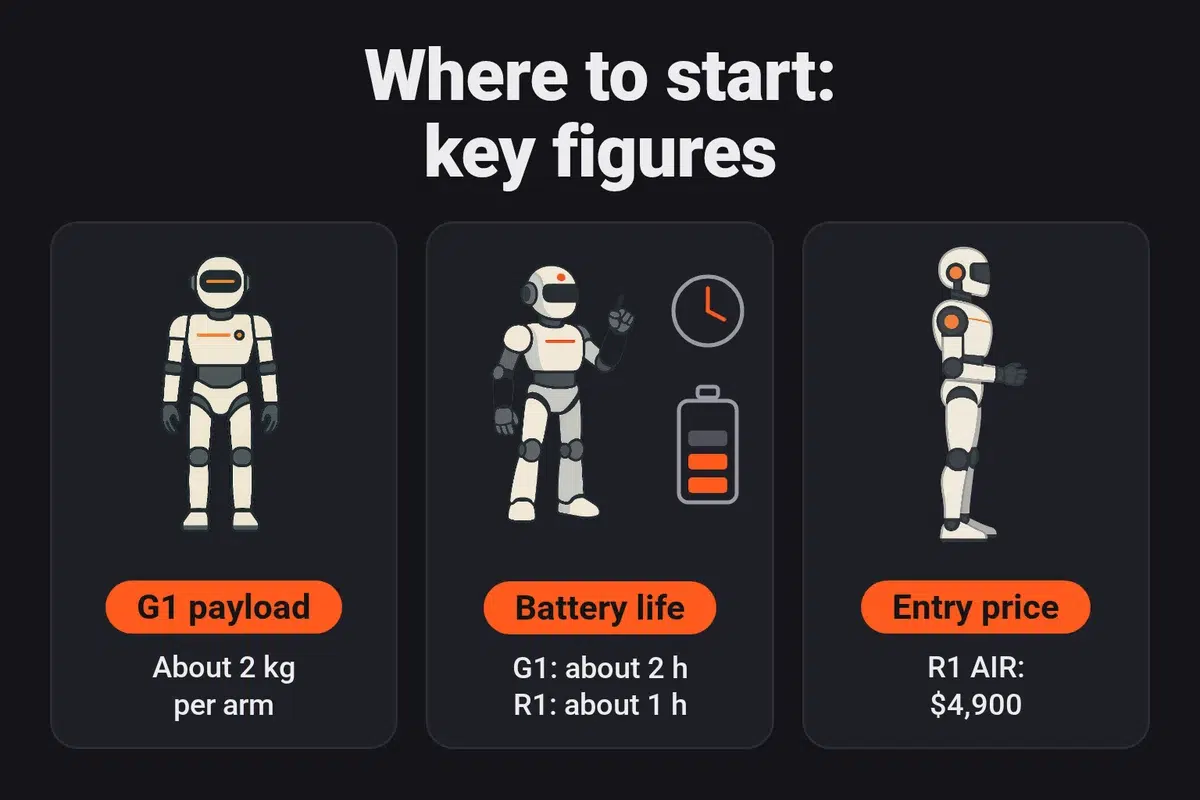
The official Unitree catalogue, checked on 20 October 2026, lists the R1 AIR at $4,900, the standard R1 at $5,900 and the standard G1 at $13,500. These prices are excl. taxes and shipping.
The European market shows different figures. In its German price survey of 2 September 2026, MonsterDealz.de listed an R1 at €9,996 and G1 units offered by six retailers at between €17,884 and €27,370.
For the G1 alone, Futura also reported a price “generally below €16,000” in a feature on Instadrone, a company based in Béziers that adapts the robot for rescue, security and inspection missions. This is a press figure, separate from the manufacturer’s catalogue and the German offers.
The robot itself is only part of the budget. Additional equipment, versions intended for advanced development, shipping and import costs also count. At the German retailer Funduino, a spare battery for the G1 was listed at €839.99 and a remote control at €297.50.
The humanoid robot price guide details the differences between models, versions and sales channels.
Unitree R1 vs G1: specs, price and warranty compared
The R1 and G1 show which features to check on a humanoid platform: claimed battery life, manipulation capability, access to development functions and warranty length.

Official Unitree specs and pricing
| Feature | R1 AIR | Standard R1 | Standard G1 |
|---|---|---|---|
| List price | $4,900 | $5,900 | $13,500 |
| Claimed battery life | About 1 h for the R1 family | About 1 h | About 2 h |
| Manipulation | R1 platform, base hands cannot grip | Base hands cannot grip | About 2 kg per arm; three-fingered hands not included in base configuration |
| Battery | Quick-release, R1 family | Quick-release | Quick-release |
| Development | R1 family with open joint and sensor interfaces | Open joint and sensor interfaces | EDU version intended for secondary development |
| Claimed warranty | 6 months | 8 months | 8 months |
Prices from the official Unitree catalogue checked on 20 October 2026, excl. taxes and shipping. Battery life and capabilities are manufacturer claims, taken in particular from the Unitree spec sheet and, for the G1, reported by heise online.
Unitree EDU versions: how they change the comparison
At Unitree, EDU versions are configurations geared towards development. The R1 EDU offers advanced development options and a claimed 12-month warranty, compared with 8 months for the standard R1.
The G1 EDU is intended for secondary development, with options including an Orin computing module and Dex3-1 hands. Its claimed warranty reaches 18 months, compared with 8 months for the standard G1.
Any comparison should therefore look at the exact configuration: base robot, manipulation hardware, computing components and software access. The Unitree R1 and Unitree G1 pages cover the two platforms separately.
What are affordable humanoid robots actually used for?
Three uses account for most early demand: research, teaching and demonstration. Each comes with different expectations, even when the robots look alike.
- Research and development: working on movement, joints, sensors and programming functions. The R1 has open interfaces, while EDU versions offer additional development options.
- Teaching: using a robotics platform for coursework and experiments. Models sold to universities and laboratories fall into this category.
- Demonstration: showing walking, gestures, dancing or pre-scripted interactions at a trade show or in a presentation setting.
The Booster T1 is another example of a research platform. Distributed in France by Génération Robots, based in Mérignac, it runs on an open-source architecture compatible with ROS 2. The distributor claimed two hours of battery life while walking and four hours standing.
A used demonstration unit was listed by Génération Robots at €31,200 incl. VAT, or €26,000 excl. VAT. Its after-sales service is handled by engineers, with a first response promised within 24 business hours.
Questions to ask before buying a humanoid robot
1. What exactly will the robot be used for?
A locomotion experiment, a teaching exercise, a public presentation and handling objects do not call on the same functions. The intended task determines which equipment and development options to look at.
2. Which version is actually on offer?
Standard and EDU versions do not necessarily offer the same programming options or the same accessories. Each configuration should be compared individually, taking into account which components are included and which are optional.
3. Can the robot’s hands grip objects?
Manipulation is one of the main technical and cost factors in a humanoid. Articulated hands, tactile sensors and actuators all add to the price of the machine.
The base R1 has hands that cannot grip. Three-fingered hands are also missing from the G1’s base configuration. Having articulated arms therefore does not automatically mean a robot can pick up and move objects.
4. What battery life is claimed?
Unitree claims about one hour for the R1 and two hours for the G1. Both families use quick-release batteries. Battery life should be weighed against the intended activity and how the robot will be used.
5. Which warranty applies to the configuration?
The warranty periods claimed by Unitree range from 6 months for the R1 AIR to 18 months for the G1 EDU. Buyers need to check the specific version, the sales channel, and the terms for repairs, returns and support.
6. What does the full configuration cost?
The listed price should be considered alongside accessories, software, shipping, taxes on arrival and any import fees. The currency and whether a price is excl. or incl. taxes matter as much as the starting price.
The guide to buying a humanoid robot in France covers these costs in more detail.
Buy now, reserve or wait: three different purchase situations
A robot appearing in a catalogue, reservations opening and physical availability are three distinct commercial situations.
The German survey by MonsterDealz.de of 2 September 2026 identified three humanoids that could be ordered with a German invoice and German statutory warranty: Unitree G1, Unitree R1 and Neura 4NE1 Mini. Of these, only the G1 was listed by a retailer as deliverable within fourteen business days.
For the R1, the press reported shipments from the official website starting in May 2026 and shipments announced on AliExpress from 30 June 2026. It also mentioned €680 for delivery to France.
The Neura 4NE1 Mini was offered for reservation by its manufacturer. As of 19 October 2026, the Standard version was estimated at €19,999 excl. VAT and the Pro at €29,999 excl. VAT, excluding delivery. The €100 reservation was described as refundable until the purchase contract is signed, with availability announced for 2026.
Home robots and demo videos: what to expect and what to avoid
The affordable platforms currently on sale should not be confused with projects for general-purpose household robots.
The 1X NEO is presented as a humanoid for consumers. The 1X catalogue of 19 October 2026 lists an Early Access option at $20,000, including a three-year warranty, premium support and priority delivery, as well as a subscription option at $499 per month. The $200 deposit is fully refundable for up to fourteen days after the invitation to order is sent, after which it becomes non-refundable.
NEO has an Expert mode that lets a 1X employee control the robot remotely inside the home. According to t3n, faces can be blurred and certain areas can be placed off-limits to the operator.
In a Wall Street Journal test reported by Notebookcheck, NEO vacuumed and loaded a dishwasher. It took more than a minute to take a bottle out of the fridge and failed to crack a nut. The robot tested was teleoperated, so these results describe tasks carried out with human assistance.
Tesla Optimus is in a different situation. Tesla has not published a sale price for Optimus. The only sourced figure is an estimate by Elon Musk of around $30,000, made in October 2024. At Davos on 22 January 2026, he placed sales to the public from the end of 2027, without giving a price. According to TechCrunch, he said on 21 October 2026 that Tesla could produce 20,000 Optimus per week by the end of 2027: a target, not a current capacity. As of today, no official Tesla reservation has been identified.
Some websites were nonetheless offering Optimus reservations, according to MonsterDealz.de. Such an offer from outside the manufacturer is not an official Tesla reservation.
What we do not know yet
Several pieces of information have not been disclosed or confirmed, making it hard to assess the actual conditions for buying and using these robots in France:
- Actual availability, stock levels and delivery times for the various humanoids on the French market.
- Whether there is an official Unitree network in France and local after-sales service for the R1 and G1.
- Official French prices incl. VAT for the Unitree R1 and G1, as well as prices for the EDU versions.
- The full contractual terms of manufacturer warranties and the cost of maintenance and repairs.
- The customs duties, VAT and import fees that actually apply to each configuration bought from France.
- The CE conformity of each model and the regulatory obligations attached to its use. The robots may fall under machinery regulations; the AI Act provisions on CE marking for high-risk AI systems follow deadlines of 2 December 2027 for Annex III and 2 August 2028 for Annex I, according to an analysis by lawyer Thiébaut Devergranne dated 18 August 2026.
- The timetable for selling the 1X NEO in France. First deliveries are announced in the United States in 2026; another communication mentions Europe in 2027.
- Real, repeatable performance on household tasks without teleoperation, beyond the documented demonstrations and tests.
See also: Buying a humanoid robot in France, Humanoid robot prices, Unitree R1, Unitree G1, The official R1 spec sheet explained, Humanoid robots listed by German retailers and The Booster T1 at Génération Robots.
The newsletter
Get the latest on humanoid robots
A selection of announcements, prices and demonstrations, with no advertising. Unsubscribe in one click.