
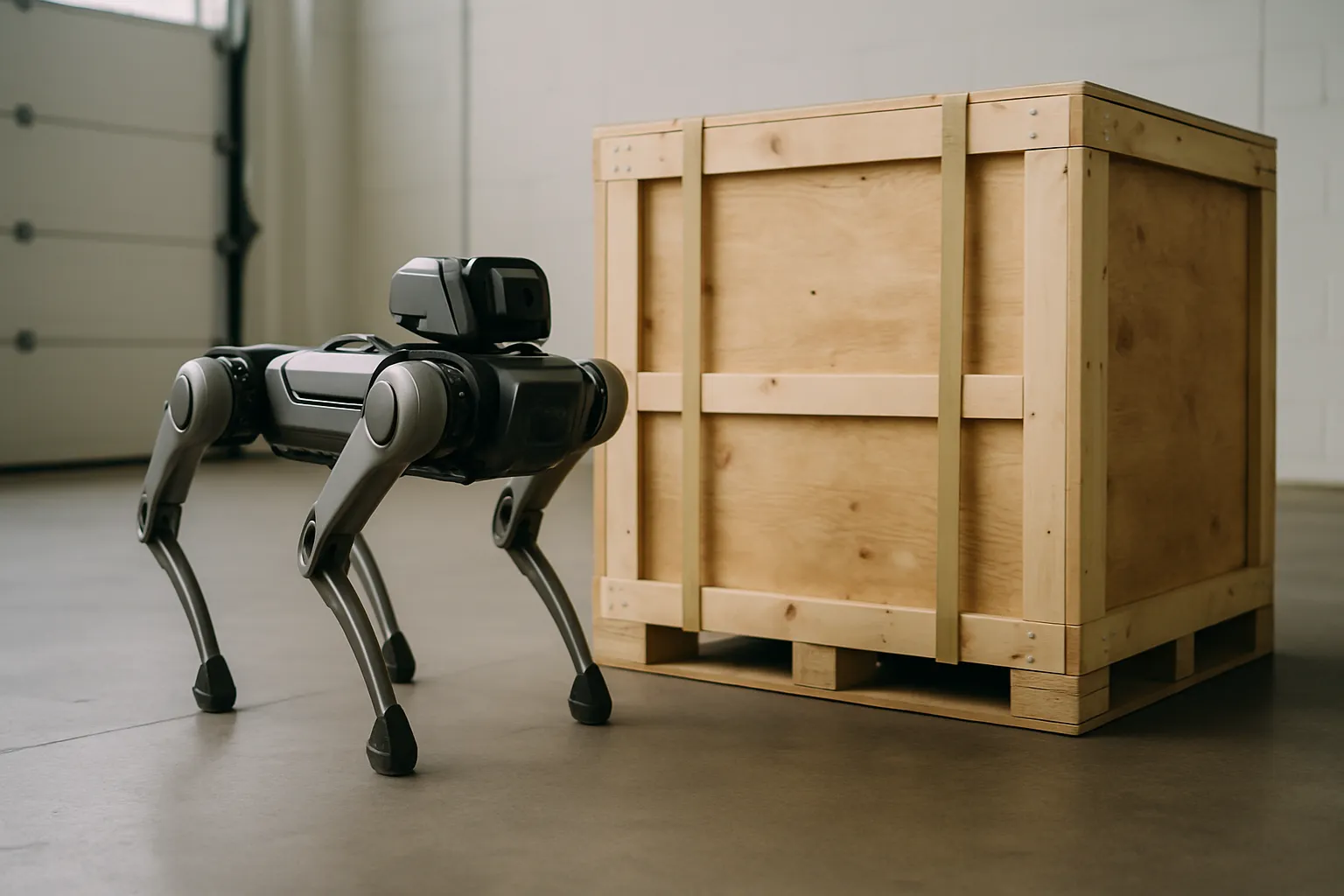
Can you actually buy a Boston Dynamics robot in 2026? It depends on the model. Spot is on sale, and the manufacturer says more than 1,500 units are with customers. Stretch is sold to logistics companies, while Atlas is starting its rollout with a select number of early users. The three robots are therefore not equally available.
The Boston Dynamics lineup is aimed mainly at industrial operations, facility inspection and logistics. As of 20 October 2026, the official pages describe the robots’ technical capabilities and professional applications but show no public price. Access to each model depends on how far along it is in commercialization and deployment.
Which Boston Dynamics robots are for sale in 2026?
Boston Dynamics offers three robots with distinct roles: Spot, a mobile quadruped used in particular for inspections; Stretch, a logistics handling robot; and Atlas, a fully electric humanoid developed for industrial tasks.
| Robot | Status as of 20 October 2026 | Documented applications |
|---|---|---|
| Spot | On sale, more than 1,500 robots with customers according to Boston Dynamics | Industrial inspection, data collection, quality control |
| Stretch | Sold to businesses, several named customers | Trailer unloading, case handling and building |
| Atlas | Initial rollout with a select number of early users | Parts sequencing and industrial operations at Hyundai |
Spot and Stretch are sold on the basis of established professional applications. Atlas is following a different path: Boston Dynamics is introducing it into industrial environments with selected partners, Hyundai in particular.
Spot: the Boston Dynamics robot already on sale
Spot is the model for which Boston Dynamics publishes the most precise adoption figure. On its official page, the manufacturer cites more than 1,500 robots with customers. This is the company’s own figure, not an independent count of installations.
The quadruped weighs 33.8 kg with its battery and moves at up to 1.6 m/s. It has 360° perception, can climb 300 mm steps and can handle slopes of up to 30°. Its stated average runtime is 90 minutes, depending on payload and environment.
Spot can carry a payload of up to 14 kg. Boston Dynamics also offers an optional integrated arm for mobile manipulation. The robot has a software programming interface and connectors for adding extra equipment.
Documented industrial uses
Spot is used in particular for inspecting industrial facilities. Its features include autonomous charging, rerouting around obstacles and automatic self-righting after a fall.
An article published on 17 October 2026 also reports its use at Hyundai to check that components are present on vehicles. It mentions deployment across hundreds of facilities, while the manufacturer cites more than 1,500 robots with its customers.
The Spot 5.2 update broadens its inspection applications. With the Orbit software, the features presented include visual inspections assisted by Google Gemini, video analysis and detection of more than 20 types of gas using the MFE Spot Connected Gas Detection system.
Video inspections can cover water leaks, indicator lights or a slipping conveyor belt, among other things. The Site Scans system is designed to identify situations such as a spill or a person in a restricted area.
These features position Spot as a mobile inspection robot that can be integrated into monitoring and maintenance processes.
Stretch: a robot sold to logistics companies
Stretch is Boston Dynamics’ second commercial product. Unlike Spot, which is designed to move around and inspect facilities, Stretch specializes in handling boxes and unloading trailers.
The manufacturer claims a throughput of hundreds of cases per hour, without giving a single numerical rate. The robot can handle boxes weighing up to 50 pounds, about 22.7 kg.
Boston Dynamics says Stretch can be deployed within days of delivery and that no prior programming is required.
Named business customers
Boston Dynamics lists several companies among Stretch customers: Otto Group, NFI, Gap, Arvato, DHL, Maersk and H&M.
This list shows that Stretch has an identified business customer base in logistics and materials handling. Its commercial status sets it apart from the Atlas program, which is still focused on early users.
Stretch is presented as a solution for unloading and building cases, deployed at customer sites.
Atlas: a humanoid robot limited to early adopters
Atlas holds a different place in the Boston Dynamics lineup. The manufacturer has announced the start of its rollout with a select number of early users, described as “early adopters”.
The fully electric humanoid robot is developed to carry out industrial operations. Hyundai is named as the partner for the first customer pilot, focused on sequencing tasks in real-world conditions.
An article published on 17 October 2026 describes Atlas sorting roof rack components bound for an assembly line at a Hyundai plant. The operation is presented as autonomous.
Its training relies in part on human demonstrations using a virtual reality headset and motion capture. The article also reports that more than 4,000 virtual copies of Atlas were trained for six hours in simulation.
Hyundai’s industrial program for Atlas
Hyundai has set a target of 25,000 Atlas robots in its factories by 2030, spread across its own sites and those of Kia. This is a deployment goal, not a fleet of 25,000 robots already in operation.
The Robotics Metaplant Application Center (RMAC), located on the Metaplant America site near Savannah, Georgia, already hosts Atlas units assigned to parts sorting, sequencing and logistics.
An expansion of the RMAC is planned for 2027, with a tenfold increase in floor space under consideration. Hyundai is also considering US production of up to 30,000 Atlas units a year. This is projected capacity, not a production level already reached.
Atlas development and integration remain gradual. The article on the Hyundai trials says permanent integration into industrial processes could take several years.
Boston Dynamics robot specifications: Spot, Atlas and Stretch
Boston Dynamics’ official spec sheets allow the three robots to be compared on the specifications the manufacturer publishes. Because their designs and functions differ, the available data does not always cover the same parameters.
Spot official specifications
| Specification | Manufacturer figure |
|---|---|
| Type | Mobile quadruped robot |
| Weight with battery | 33.8 kg |
| Width | 500 mm |
| Standing height | 610 mm by default, adjustable from 520 to 700 mm |
| Maximum speed | 1.6 m/s |
| Maximum slope | ±30° |
| Step height | 300 mm |
| Maximum payload | 14 kg |
| Battery capacity | 564 Wh |
| Battery weight | 5.2 kg |
| Average runtime | 90 minutes |
| Standby time | 180 minutes |
| Charging time | 60 minutes |
| Ingress protection rating | IP54 |
| Operating temperature | -20 to 55 °C |
| Perception | 360° |
| Hardware interfaces | M5 T-slot rails, two DB25 connectors |
| Software interfaces | API and hardware interface control document |
| Robotic arm | Integrated, optional |
Atlas official specifications
| Specification | Manufacturer figure |
|---|---|
| Type | Fully electric humanoid robot |
| Height | 1.9 m |
| Weight | 90 kg |
| Instantaneous payload | 50 kg |
| Sustained payload | 30 kg |
| Degrees of freedom | 56 |
| Reach | 2.3 m |
| Range of motion | Continuous |
| Stated runtime | 4 hours |
| Battery | Self-swappable at a charging station |
| Ingress protection rating | IP67 |
| Operating temperature | -20 to 40 °C |
| Perception | 360° camera vision and tactile sensing |
Stretch official specifications
| Specification | Manufacturer figure |
|---|---|
| Function | Trailer unloading and case building |
| Handling capacity | Hundreds of cases per hour |
| Maximum box weight | 50 pounds, about 22.7 kg |
| Stated deployment time | A few days after delivery |
| Prior programming | Not required, according to Boston Dynamics |
Can individuals buy a Boston Dynamics robot?
Boston Dynamics’ documented sales are to businesses and professional settings. Spot is used for inspection and quality control, Stretch for logistics operations and Atlas for industrial pilots.
The named customers are companies such as Hyundai, DHL, Maersk, Gap and Otto Group. The Atlas program relies on a selection of early users, while Spot and Stretch already have commercial customers.
As of 20 October 2026, none of the three models is presented in the available official information as a consumer robot sold to individuals. Spot’s place in the commercial lineup does not mean it is offered as a home product.
What we do not know yet
Several key details about Boston Dynamics’ commercial terms and deployments remain undisclosed as of 20 October 2026.
- Price: no public price for Spot, Stretch or Atlas was found on the manufacturer’s official pages. The price of each model remains undisclosed.
- Availability in France and Europe: sales terms and commercial availability in these markets have not been established.
- Lead times: order and delivery times for Spot and Stretch are not specified. No general availability date has been announced for Atlas.
- Atlas: the exact number of units actually deployed and independently measured performance are not known.
- Stretch: independently measured handling throughput, runtime figures, dimensions and the robot’s reach are not specified.
- Spot: detailed technical specifications for the optional robotic arm are not published in the information reviewed.
- Individuals: no consumer sales offer and no delivery date for individual buyers is documented.
Spot and Stretch are therefore established commercial products for professional buyers, while Atlas remains in a selective deployment phase. The exact terms of access to the robots, including their prices and availability in the French market, have yet to be specified by Boston Dynamics.
See also: Boston Dynamics Atlas: humanoid specifications and deployment; Boston Dynamics Spot: quadruped robot specifications and applications; Hyundai plans 25,000 Atlas robots in its factories by 2030; Spot 5.2: video inspections with Gemini and detection of more than 20 types of gas.
The newsletter
Get the latest on humanoid robots
A selection of announcements, prices and demonstrations, with no advertising. Unsubscribe in one click.