
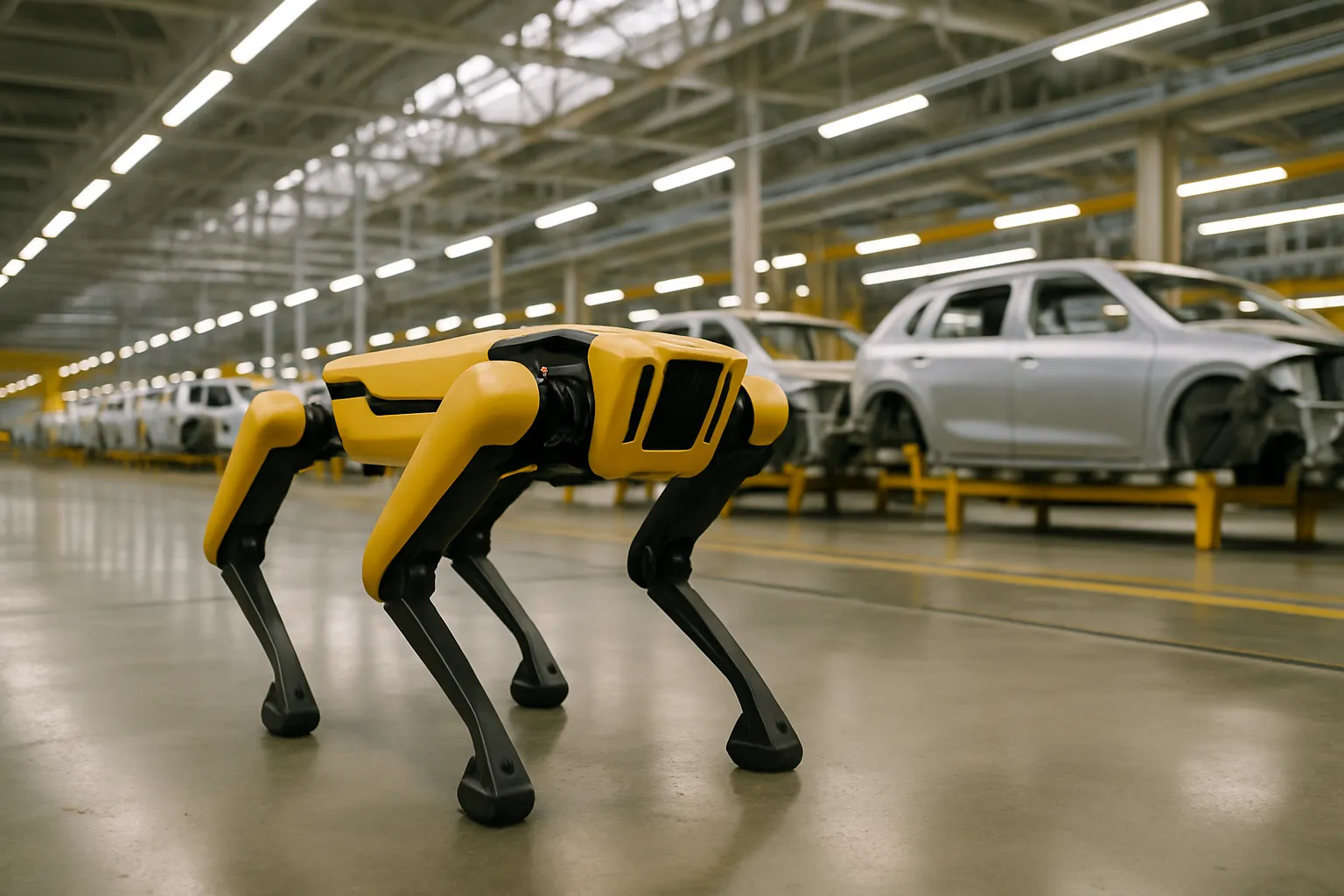
Boston Dynamics develops three robots with distinct architectures and functions: Atlas, an electric humanoid built for industrial operations; Spot, a mobile quadruped used in particular for inspection; and Stretch, a logistics robot for box handling. The company, which is majority-controlled by Hyundai, now pairs its machines with software for management, perception and artificial intelligence.
The Boston Dynamics lineup covers several forms of mobile robotics. Atlas walks on two legs and handles objects. Spot works in industrial facilities with onboard sensors and equipment. Stretch automates the handling of boxes in logistics operations. The three platforms serve different purposes and each has its own technical characteristics.
Boston Dynamics’ development is also part of Hyundai’s industrial strategy. The group already uses robots in its facilities, is taking part in the first Atlas customer pilot and has set a target of 25,000 humanoids in its factories by 2030. In parallel, Boston Dynamics is developing Orbit, a software platform that centralises inspections and integrates, among other things, the visual analysis capabilities of Google Gemini.
Who owns Boston Dynamics? A robot maker controlled by Hyundai
Boston Dynamics is a manufacturer of mobile robots majority-controlled by the Hyundai group. Its business rests on three platforms: the Atlas humanoid, the Spot quadruped and the Stretch logistics robot. Each has an architecture suited to the operations it is meant to carry out.
Hyundai plays a major role in the industrial development of Atlas. The carmaker is the partner for the first customer pilot announced by Boston Dynamics, which involves parts sequencing under real-world conditions. This collaboration supports the humanoid’s gradual move from development phases to industrial applications.
The relationship goes beyond the Atlas trials. Spot is also used at Hyundai to check that components are present on vehicles. The car group therefore serves as a testing ground for several Boston Dynamics robotics technologies.
The company is also developing a software layer to organise missions and make use of the data collected by its robots. This direction is particularly visible in the changes to Spot and to the Orbit platform.
Atlas, Spot and Stretch specs: Boston Dynamics’ three robots compared
The three robots in the lineup differ in mobility, manipulation capability and operating environment. The specifications below come from the official Boston Dynamics product sheets, consulted on 20 October 2026. The payload figures are not directly comparable, as they correspond to different conditions of use.
| Specification | Atlas | Spot | Stretch |
|---|---|---|---|
| Robot type | Electric humanoid | Mobile quadruped | Logistics handling robot |
| Main function | Parts handling and sequencing | Mobile inspection and data collection | Truck unloading and case handling |
| Height | 1.9 m | 610 mm standing by default, adjustable from 520 to 700 mm | Not disclosed |
| Weight | 90 kg | 33.8 kg with battery | Not disclosed |
| Handling capacity or payload | 50 kg instantaneous, 30 kg sustained | 14 kg maximum payload | Boxes up to 50 pounds, or about 22.7 kg |
| Runtime | 4 hours | 90 minutes on average | Not disclosed |
| Protection rating | IP67 | IP54 | Not disclosed |
| Operating temperature | -20 to 40 °C | -20 to 55 °C | Not disclosed |
| Notable feature | 56 degrees of freedom and autonomous battery swapping | 360° perception, autonomous charging and optional arm | Deployment announced within a few days of delivery |
These values are the specifications announced by Boston Dynamics. Spot’s runtime figures depend in particular on the onboard payload and the environment. For Stretch, the company announces a rate of several hundred boxes per hour without giving a single figure.
Atlas: Boston Dynamics’ electric humanoid robot for industry
Atlas is Boston Dynamics’ humanoid robot. Its all-electric design replaces the hydraulic architecture mentioned in publications about its development. It stands 1.9 m tall, weighs 90 kg and has 56 degrees of freedom.
The company announces a reach of 2.3 m, continuous range of motion and perception that combines tactile sensors with 360° camera vision. Its payload reaches 50 kg instantaneously and 30 kg in sustained use.
Atlas has an announced runtime of four hours. It can swap its own battery at a charging station, a feature designed to keep operations running without systematic manual battery changes.
Boston Dynamics plans to start with a selected group of early users. Hyundai is taking part in this first phase with component sequencing tasks in a real industrial environment.
Development work also includes learning from human demonstration and simulation. The humanoid is designed to acquire manipulation skills before they are transferred to physical operations.
Spot: a quadruped robot for industrial inspection
Spot is Boston Dynamics’ quadruped robot. It moves through industrial environments, collects information and can carry measurement or inspection equipment.
Weighing 33.8 kg including its battery, Spot reaches a top speed of 1.6 m/s. It can climb a 300 mm step and handle slopes of up to 30°. Its 360° perception allows it to take account of obstacles around it.
Its 564 Wh battery provides an announced average runtime of 90 minutes. The company also states 180 minutes on standby and 60 minutes to recharge. The robot has autonomous charging, can replan its route around obstacles and has a self-righting system.
Spot can carry up to 14 kg of payload. It has M5 T-slot mounting rails, two DB25 connectors and a software application programming interface. An integrated arm is available as an option for mobile manipulation.
Boston Dynamics says more than 1,500 Spot robots are in use with its customers. The company links this installed base to the development of new inspection and fleet management features.
Stretch: a robot for warehouse box handling
Stretch is designed to automate the handling of cases and boxes. Boston Dynamics presents two main functions: unloading trucks and handling cases in logistics facilities.
The company announces the handling of several hundred boxes per hour, with the ability to pick up packages weighing up to 50 pounds, or about 22.7 kg.
Boston Dynamics says Stretch can be deployed within a few days of delivery and requires no prior programming for installation, under the conditions set out on its product sheet.
Customers cited by the company include Otto Group, NFI, Gap, Arvato, DHL, Maersk and H&M. The list reflects its positioning in logistics and parcel handling, separate from Spot’s inspection missions and Atlas’s industrial manipulation.
Hyundai and Atlas: from first pilots to a 25,000-robot target
Hyundai plays a dual role in Boston Dynamics’ development: majority shareholder and industrial partner for testing and gradually deploying the robots.
The group plans to have 25,000 Atlas robots in its factories by 2030. The target covers Hyundai and Kia sites and is part of a plan to industrialise the humanoid at scale.
The Hyundai programme for 25,000 Atlas robots by 2030 also includes a US production project with a capacity of up to 30,000 units per year. This is a planned capacity, not an annual manufacturing volume already achieved.
Part of the development is organised around the Robotics Metaplant Application Center (RMAC), located on the Metaplant America site near Savannah, Georgia. Atlas robots are already carrying out parts sorting, sequencing and logistics operations there.
An expansion of the RMAC is planned for 2027. One option under study is a tenfold increase in its floor area. The centre contributes to the preparatory work needed for broader industrial use of humanoids.
The programme also raises social questions. The Kia union has asked for a dedicated officer to be appointed to protect employees’ rights as artificial intelligence and robotics expand. Hyundai, for its part, plays down concerns about possible job cuts.
How Atlas learns to handle parts in Hyundai factories
Atlas’s industrial trials focus in particular on sorting and sequencing components for car assembly lines.
In a Hyundai factory, Atlas was shown sorting roof rack components. The operation is described as autonomous and aims to prepare the parts in the order in which they are needed on the line.
These skills are developed in part through human demonstrations. Operators use a virtual reality headset and a motion capture system to pass examples of movements on to the robot.
These demonstrations are supplemented by training in simulation. More than 4,000 virtual copies of Atlas were trained for six hours in a simulated environment. This method multiplies learning situations without tying up as many physical machines.
The development, led by Zach Jackowski, also uses NVIDIA processors. The work combines robot learning, simulation and trials in industrial facilities.
The Hyundai plant featured in this work has more than 1,000 industrial robots and close to 1,500 people. Atlas joins an environment where automation already plays a major role. Its permanent integration, however, is part of a gradual process that could take several years.
Orbit: Boston Dynamics’ software for managing robotic inspections
Boston Dynamics does not only develop mechanical platforms. With Orbit, the company offers software for managing robot fleets and the information produced by inspections.
Orbit organises data around industrial equipment. The platform can import asset hierarchies and attach metadata to each installation, such as its location, type, criticality, manufacturer or model.
This structure allows inspection results to be linked to the equipment concerned rather than kept as isolated observations.
Orbit has much in common with several categories of industrial software:
- CMMS, for computerised maintenance management.
- MES, for manufacturing execution systems.
- EAM, for enterprise asset management.
The platform also has an open API for integrating data from other equipment, including programmable logic controllers (PLCs) and security cameras.
This architecture forms the basis of an inspection management system in which Spot’s observations can be cross-referenced with information from other industrial systems.
Gemini and Spot 5.2: new inspection features
Spot’s software updates extend inspections beyond simply collecting images and measurements. Boston Dynamics now combines Orbit with Google Gemini to analyse certain visual situations.
Visual recognition with Orbit AIVI
The integration of Gemini into Orbit AIVI makes it possible to use images captured during inspections. The examples shown include reading gauges, observing indicator lights, checking pallets, verifying levels and analysing 5S boards.
With AIVI-Learning, Boston Dynamics extends this approach to video inspections. The system is designed to spot situations such as a water leak, a slipping conveyor belt or a change in an indicator light’s status.
The Site Scans feature organises visual searches across a site. By default it covers the entire site, with the option of defining specific zones and time slots. Target situations include spills, a person in a restricted area and suspicious bags.
These features are covered in detail in the changes brought by Spot 5.2, with video inspections and new detection capabilities.
Gas, vibration and partial discharge detection
The new inspection features also include several specialised measurement solutions.
The MFE Spot Connected Gas Detection system is presented as able to detect more than 20 types of gas. Boston Dynamics also mentions visual vibration analysis and the integration of the Sorama L642 sensor to look for partial discharges in electrical installations.
The applications cited for this last feature include cables, electrical bushings and high-voltage transformers.
These capabilities rely on separate equipment and processing. They widen the range of phenomena Spot can look for during its inspection rounds.
Missions triggered by industrial systems
Orbit’s development also includes work on an MCP layer intended to let artificial intelligence agents trigger Spot missions based on business rules.
Two categories of scenarios are envisaged: equipment reliability and safety. In this architecture, information from an industrial system can be used to send the robot to the area concerned.
This direction is explained in the presentation of Orbit combined with Gemini and Spot’s deployment on alert in factories. The automatic triggering scenarios correspond to the possibilities described by Boston Dynamics.
Availability: where each Boston Dynamics robot stands commercially
The commercial status of Boston Dynamics robots varies from one platform to another.
Spot already has a claimed installed base of more than 1,500 robots at the company’s customers. Boston Dynamics continues to develop the platform with software updates, sensors and optional equipment.
Stretch is presented as a logistics solution deployed with business customers, particularly in parcel handling. The company cites several user companies and describes a fast installation process after delivery.
Atlas is in a different position. Boston Dynamics announces a start with selected early users, with Hyundai as partner for the first customer pilot. Hyundai’s industrial target for 2030 accompanies this gradual deployment phase.
Commercial terms, the differences between platforms and public information on how to acquire them are gathered on the page Can you buy a Boston Dynamics robot?.
What we do not know yet
Several pieces of information have not been disclosed or lack sufficiently precise public data as of 20 October 2026.
- Price: no confirmed public price for Atlas, Spot or Stretch in the official product sheets consulted. For Stretch, the company refers buyers to its sales team.
- Availability: no general release date has been announced for Atlas. Sales and availability terms for the three robots in France and the rest of Europe have not been established.
- Atlas deployment: the exact number of humanoids physically deployed has not been disclosed. The target of 25,000 units at Hyundai by 2030 and the planned production capacity of 30,000 units per year are not volumes already achieved.
- Atlas performance: no independent measurements are available to confirm its real-world manipulation performance, productivity or runtime in extended industrial operation.
- Stretch: the actual rate measured in operation is not specified. Its dimensions, reach and runtime figures are not disclosed in the available specifications.
- Spot arm: Boston Dynamics announces an optional integrated arm, but its detailed technical specifications are not included in the information used here.
- Inspection features and artificial intelligence: no independently measured deployment results are available to quantify the success rates of the new visual and video detections or of the automatic triggering scenarios driven by AI agents.
See also: Boston Dynamics Atlas: specs of the electric humanoid; Boston Dynamics Spot: specifications of the quadruped robot; Can you buy a Boston Dynamics robot? Price and availability; Atlas sorts parts at Hyundai using human demonstration learning; Hyundai plans 25,000 Atlas robots in its factories by 2030; Spot 5.2: video inspections with Gemini and gas detection; Orbit and Gemini: Spot deploys on alert in factories.
The newsletter
Get the latest on humanoid robots
A selection of announcements, prices and demonstrations, with no advertising. Unsubscribe in one click.