

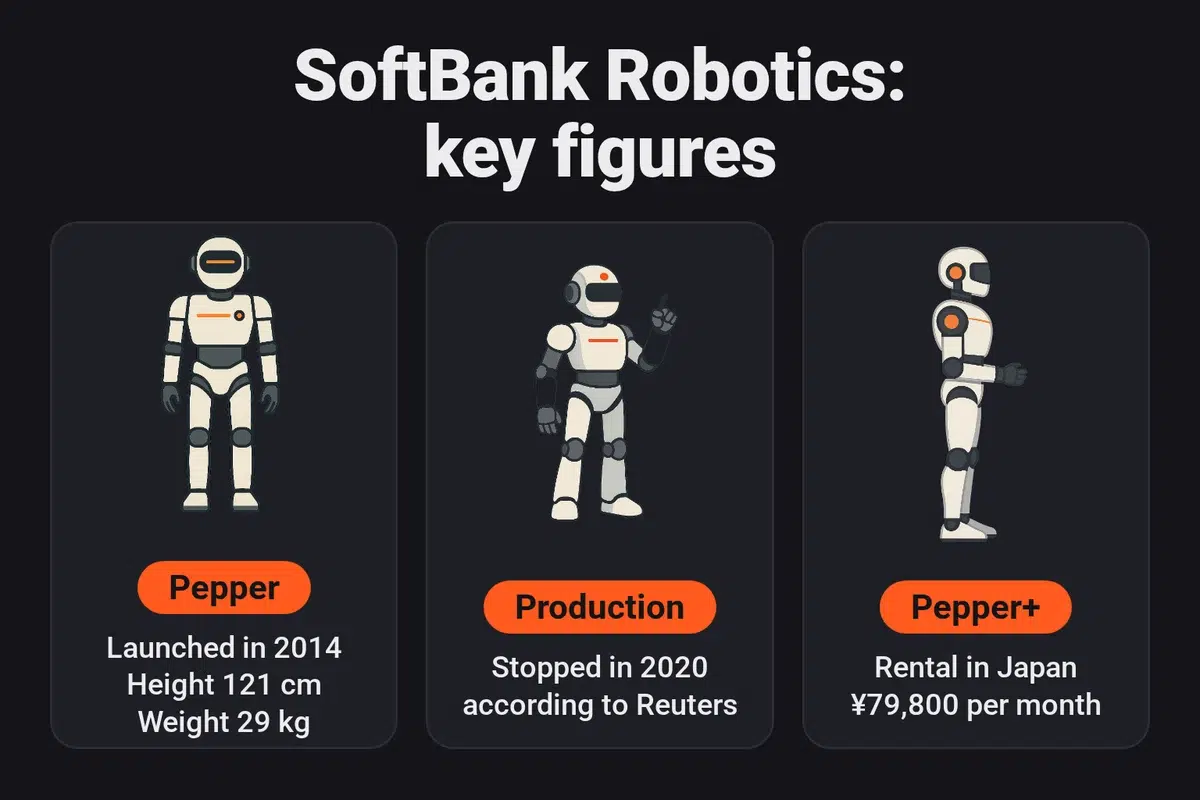
The SoftBank Robotics name is still tied to Pepper, the small white humanoid with a tablet launched in 2014. Yet the group has changed business. It now describes itself as a “robot integrator”, and its announcements cover automated kitchens, floor cleaning, building management and the Servi Q service robot. Pepper and NAO went a different way: the former French subsidiary Aldebaran, sold in 2022, was liquidated in 2025 and its assets passed under Chinese control. The one exception is Pepper+, announced in Japan in early 2026 and offered for rental only.
SoftBank Robotics today: a robot integrator with no humanoid in development
On its website, SoftBank Robotics Group describes Pepper as “our first robot”, launched in 2014. The company claims the “number 1 global sales position” in the market for professional indoor mobile robots, citing a Grand View Research report dated April 2022. It also says its robots are used in more than 70 countries and that it has produced more than 40,000 of them.
The group’s home page and “About” page make no mention of Pepper+, the Whiz vacuum cleaner or any current humanoid. No humanoid robot in development and no humanoid strategy appear in the site’s news listings.
What SoftBank Robotics sells today
The news items published in 2026 outline the actual scope of the business:

- 25 March 2026: SoftBank Robotics America acquires GCC to launch Smart Building X (SBX);
- 17 April 2026: SoftBank Robotics America partners with Matternet on last-mile delivery;
- 1 May 2026: US debut of the STEAMA and FLAMA kitchen robots;
- 14 May 2026: expanded partnership with Direct Supply in senior living communities;
- 27 August 2026: Flagship expands its floor-cleaning programme with SoftBank Robotics America to more than 200 robots across 25 airports;
- 3 September 2026: global expansion of the STEAMA steam-cooking robot;
- 28 September 2026: launch of the Servi Q service robot in Japan;
- 30 September 2026: expansion of AI and robotics solutions for food service in EMEA, announced from France;
- 12 October 2026: partnership in Singapore between SoftBank Robotics Singapore and SJ Integrated Solutions on an AI-driven facility management solution.
Automated kitchen robots: STEAMA, FLAMA and BOTINKIT Omni
A press release from SoftBank Robotics UK Ltd. dated 1 October 2026 sets out the food-service range. STEAMA automates steam cooking and serves a meal “in approximately 90 seconds”; the company says recipes from more than 800 brands are available on it. FLAMA handles multi-step automated cooking. BOTINKIT Omni targets institutional catering, preparing up to 30 portions at a time, with a platform of more than 10,000 recipes.
Servi Q service robot, developed with Bear Robotics
Servi Q was developed with Bear Robotics for tight spaces. According to the press release, its body is 35 cm wide and it can move through 45 cm aisles, which the company presents as “the narrowest in its class”. Its ability to reverse is described as an industry first, based on a Bear Robotics study current as of 1 September 2026. SoftBank Robotics is its exclusive global seller. The robot was launched in Japan on 28 September 2026. Other machines in this category are covered on the page dedicated to reception and service robots.
SoftBank Robotics at EquipHotel Paris
SoftBank Robotics UK Ltd. announced it would take part in EquipHotel 2026 in Paris, from 2 to 5 November 2026, as part of its expansion of food-service automation in EMEA. Four solutions are on show: STEAMA, FLAMA, BOTINKIT Omni and Servi Q.
Pepper robot: history and specifications
The Pepper page on SoftBank’s Japanese website states that “Pepper was born on 5 June 2014”. According to Reuters, the robot was launched that year by Masayoshi Son. The same page notes that Pepper was named an “ambassador” by the Office for COVID-19 and Other Emerging Infectious Disease Control at Japan’s Cabinet Secretariat. It shows no price and states that pricing “depends on the setting or field of use”.
| Specification | Official value |
|---|---|
| Height | 121 cm |
| Dimensions (height × width × depth) | 1,210 × 480 × 425 mm |
| Weight | 29 kg |
| Battery | Lithium-ion, 30.0 Ah / 795 Wh |
| Stated date of birth | 5 June 2014 |
When did Pepper production stop: 2020 or 2021?
On 28 June 2021, Reuters reported, citing three sources, that SoftBank had halted Pepper production in 2020. One of those sources put the number of units built at 27,000, and two of them said restarting production would be costly. SoftBank said at the time that it remained committed to Pepper. In a dispatch dated 2 June 2025, AFP puts the end of production “in 2021”.
In a second article, dated 21 July 2021, Reuters said production had taken place at a Foxconn plant in China, halted in 2020, and that the line had since been dismantled. According to documents seen by the agency, fewer than 2,000 units remained in stock and sales sometimes fell below 100 robots a month. Minutes of an internal meeting in late May 2021 referred to ending sales of new Pepper units by 2023. SoftBank disputed the document, and its marketing director Kazutaka Hasumi said: “We will still be selling Pepper in five years”. Also according to Reuters, Kenichi Yoshida of SoftBank Robotics reported 8,000 Whiz vacuum cleaners ordered in the April-June 2021 quarter. At the same time, The Robot Report described Whiz as the group’s new “flagship” robot.
The Robot Report added that SoftBank Robotics Europe had reportedly lost $38 million in the 2019-2020 financial year. It quoted an anonymous employee as saying that “the market for Nao and Pepper is smaller than expected”. Reuters also reported plans to cut half of the Paris workforce.
Aldebaran: from SoftBank to liquidation
2005-2022: SoftBank’s French subsidiary
Aldebaran was founded in Paris in 2005 by Bruno Maisonnier. According to AFP, the company was owned by SoftBank Robotics Group from 2012 and later renamed SoftBank Robotics Europe. The Robot Report also dates the acquisition to 2012 and puts its value at $100 million.
In 2022, the company was bought by Germany’s United Robotics Group, a subsidiary of the RAG-Stiftung foundation, according to AFP. TechCrunch reported on 20 September 2022 that the division was reverting to the Aldebaran name and becoming one of United Robotics Group’s eight brands, with no sale price disclosed. The new owner said at the time it wanted to “improve our offerings for existing products like Pepper and Nao”. TechCrunch described Pepper as mostly used for signage in airports and restaurants. An undated page on SoftBank Robotics’ EMEA website, going back to 2022, states that SoftBank Robotics Europe was renamed Aldebaran Robotics in June 2022. Enquiries about Pepper and NAO in EMEA are redirected there to Aldebaran, while SoftBank Robotics UK Ltd, in London, handles Whiz and Keenbot.
2025: safeguard proceedings, receivership, then liquidation
According to AFP, Aldebaran was placed in safeguard proceedings in January 2025, then in receivership in February 2025, on 17 February according to management quoted by the agency. The Paris commercial court ordered its compulsory liquidation on Monday 2 June 2025, with immediate cessation of business. Thomas Novalic, lawyer for the works council, said 106 employees were being laid off. Othman Meslouh, a works council member, said the workforce had shrunk from 360 to 180 over the years.
Two takeover bids had been filed. The one from Jean-Marie Van Appelghem covered only the conversational robots for autistic children, with no contracts in France. The one from Malik Bachouchi had first been withdrawn, then refiled on the morning of the hearing without new funding, and was ruled inadmissible. Maddyness and FrenchWeb reported the same facts.
Two months earlier, on 16 April 2025, Mac4Ever gave a different account of the crisis, which should be treated as a set of press allegations. The site put the workforce at 162 before the restructuring plan, with 99 kept on. United Robotics Group allegedly refused to fund the redundancy plan, which was ultimately covered by the wage guarantee scheme. Also according to Mac4Ever, the Plato robot sold for €12,500, but Aldebaran allegedly received only €135 per sale. The French subsidiary reportedly carried most of the production and R&D, while the German head office handled distribution and marketing.
July 2025: Maxvision acquires the assets
The Robot Report announced on 19 July 2025 that Maxvision Technology Corp., a Shenzhen company specialising in biometric authentication and video identification, had acquired Aldebaran’s key assets, including Nao and Pepper. The buyer planned to set up a French subsidiary for R&D and customer service, with manufacturing in China. The site reported cumulative sales of around 20,000 Nao and 17,000 Pepper units in 70 countries. On 22 July, heise online said the deal covered the technology assets and intellectual property of both robots. Maxvision said it intended to continue both product lines, planned no layoffs and would invest in Europe and North America, for an undisclosed price. The site also reported universities’ fears that Pepper and Nao would no longer receive updates.
On 7 September 2025, Solutions Numériques gave further details of the July auction. The reserve price was set at €500,000, and Maxvision won all the assets (patents, code, inventory) for €900,000. This figure appears only in that article. The publication notes that RobotLAB, the long-standing distributor in the United States and South America, had bought the Nao and Pepper lines for those territories in 2020-2021 and sold around 8,000 robots, nearly 25% of global sales. It puts the installed base at around 37,000 units: about 20,000 Nao since 2005 and 17,000 Pepper since 2014. This figure of 17,000 Pepper units, also cited by The Robot Report in 2025, differs from the 27,000 units built that a Reuters source gave in 2021. According to Solutions Numériques, a NAO7 was planned for 2026 and production remained in China. Maxvision said it wanted to “preserve Aldebaran’s legacy”.
Maxtronics, formerly Aldebaran
The aldebaran.com domain now redirects to maxtronics.com, the website of Maxtronics Robotics SAS, based in Issy-les-Moulineaux, which presents itself as the former Aldebaran. Its menu lists NAO6, the NAO Activities licence and a “NAO7 project”. Maxtronics claims “more than 20,000 NAO produced, sold and delivered”, “more than 3,600 studies” carried out with the robot, and use in more than 70 countries with more than 30 international partners. Its support page describes Aldebaran and United Robotics Group as “permanently closed”.
For Pepper, Maxtronics says it provides no technical support, as its assistance is “limited to NAO 6”. There is no official Pepper support centre in Europe, and the company is looking for a European partner to take over sales, repair and support. Pepper’s cloud services were due to end on 1 October 2026; apps remained downloadable from the Aldebaran app store until that date. On the software side, Pepper 1.6 and 1.7 run only on NAOqi 2.5 (Python), while Pepper 1.8A and 1.8 support both NAOqi 2.5 and 2.9 (Android).
NAO6 operates between 5 °C and 35 °C. On Maxtronics’ pricing page, captured on 31 March 2026, the robot itself is sold on quotation. The NAO Activities generative AI licence, based on OpenAI’s ChatGPT and available only for NAO6, starts at €990 excl. VAT per year, with a one-month free trial. Accessories and pricing are detailed on the Pepper and NAO and Can you buy a SoftBank robot, Pepper or NAO? pages.
Pepper+ rental price in Japan
SoftBank Robotics announced Pepper+ on 2 February 2026, according to GIGAZINE. The SoftBank Robotics Japan product page presents it as a “NEW MODEL”, with more natural movements, a new tablet and AI features. These include a reception agent that recognises customers’ clothing and facial expressions, impromptu photographer, musical and quiz apps, and apps for care facilities. GIGAZINE cites tourism, healthcare and care services as target sectors and notes that only the reception agent is available, with the other apps “in development”. The site also lists the sensors: touch sensor, microphone, 2D camera and 3D sensor in the head; gyroscope, hand touch sensors, infrared, laser, sonar and bumpers in the body. On the same day, according to Japanese reports, SoftBank Robotics announced that Guinness World Records had recognised Pepper as the first mass-produced humanoid robot.
Pepper+ is offered for rental only, with no purchase price. The official Japanese price list has three plans:
- “AI活用” retail plan: ¥79,800 per month, plus ¥9,800 in initial fees, with a one-year commitment;
- short-term plan: ¥150,000 for one month’s rental, plus ¥9,800 in initial fees, with extensions charged at ¥5,000 per day;
- care facility plan: from ¥39,800 per month, plus ¥120,000 in initial fees, for a minimum of one year.
Maintenance is included in the monthly payments. Content for the AI reception agent and entry and exit management are charged separately. The usual lead time is 3 to 4 weeks. Installation requires network access, a flat, hard floor with no slope or steps, a clear radius of at least 90 cm, and indoor use.
What we do not know yet
- The exact date Pepper production stopped: 2020 according to Reuters, 2021 according to AFP.
- The exact number of Pepper and NAO units sold or produced, as figures vary between sources.
- The actual state of Pepper and NAO6 production under Maxvision and Maxtronics, and whether NAO7 exists and when it will be released, as Maxtronics publishes no content about it.
- Who manufactures Pepper+, its hardware specifications (dimensions, weight, battery), which are not on the product page, and its availability outside Japan.
- Whether Pepper is currently on sale: the official softbank.jp page does not say whether the robot is still sold.
- Purchase prices for NAO6 (on quotation), Pepper+ and any used Pepper.
- The European partner that would take over Pepper sales, repair and support.
- The full NAO6 specifications, which Maxtronics publishes as a document that was not consulted.
- Prices, lead times and availability terms in France for Servi Q, STEAMA, FLAMA and BOTINKIT Omni, which are missing from the 1 October 2026 press release.
- The detailed content of the other 2026 announcements (SBX, Matternet, Direct Supply, Flagship, Singapore), of which only titles and dates are published.
- Any humanoid strategy at SoftBank Robotics group, on which no source provides information.
- Whiz’s current specifications and availability in France.
See also: Pepper and NAO: specifications, history and support; Can you buy a SoftBank robot, Pepper or NAO?; Reception and service robots.
The newsletter
Get the latest on humanoid robots
A selection of announcements, prices and demonstrations, with no advertising. Unsubscribe in one click.