

Several humanoid robots are now listed at under €20,000, but their prices do not cover the same equipment or the same sales conditions. Across the Unitree platforms, the offers from European retailers and the Neura 4NE1 Mini, the differences lie as much in configuration and possible uses as in price.
This comparison only includes humanoid robots with a dated public price below €20,000, quoted in euros or US dollars with no conversion. Official manufacturer prices are kept separate from retailer offers and from estimates published in the press. To place these models in the wider market, the Comparisons section also covers the other categories of humanoid robots.
Which humanoid robots cost less than €20,000?
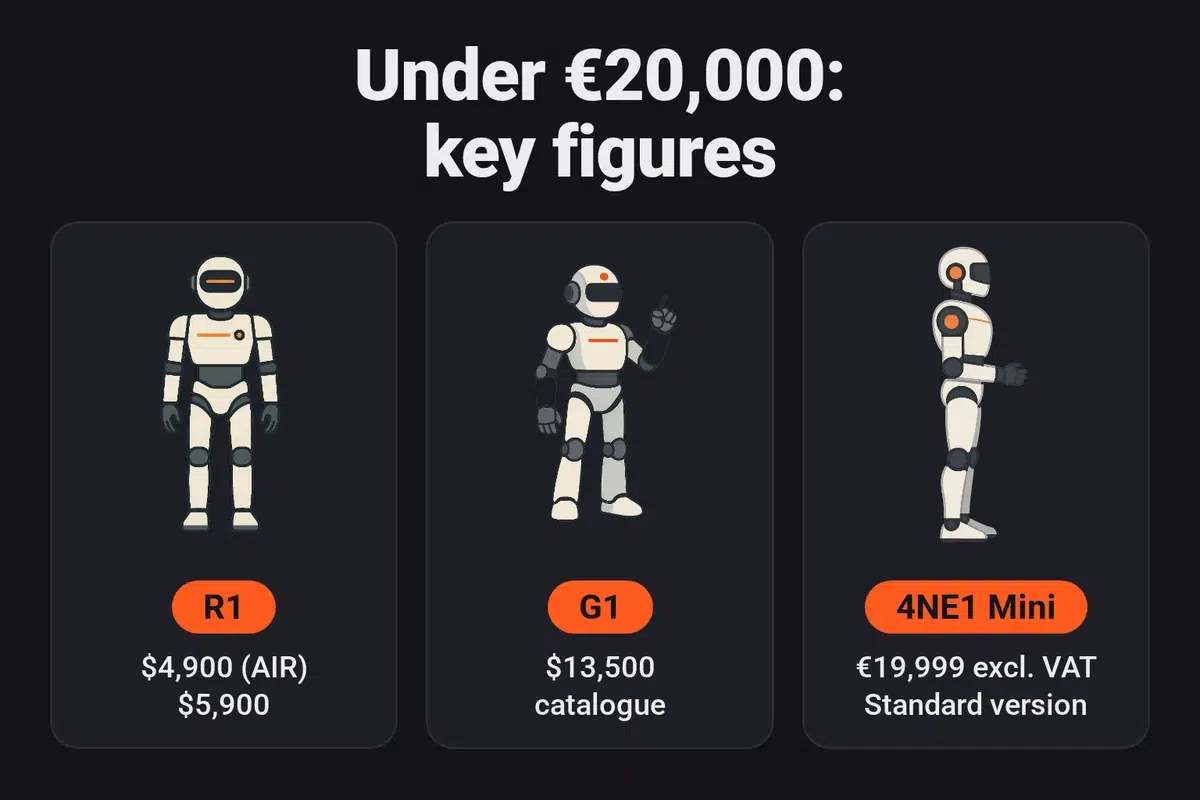
Four models meet the price criterion: the Unitree R1 AIR, R1 standard and G1 standard, plus the Neura 4NE1 Mini Standard. All three Unitree models have an official list price in US dollars, while Neura quotes a price in euros excluding VAT and shipping.
European offers also make it possible to compare the prices retailers actually display, particularly for the Unitree R1 and G1. These are not official French prices.
| Humanoid robot | Version | Public price | Source and date | Documented features and positioning |
|---|---|---|---|---|
| Unitree R1 | AIR | $4,900 | Official Unitree catalogue, 20 October 2026, excl. taxes and shipping | Walking humanoid in the R1 range |
| Unitree R1 | Standard | $5,900 | Official Unitree catalogue, 20 October 2026, excl. taxes and shipping | Walking humanoid, separate from the dual-arm R1-D platform |
| Unitree G1 | Standard | $13,500 | Official Unitree catalogue, 20 October 2026, excl. taxes and shipping | Walking humanoid, base configuration without three-finger hands |
| Unitree G1 | Standard, European offer | From €17,884 | MonsterDealz.de and Notebookcheck, 2 September 2026, six German retailers | Standard G1 sold by European retailers |
| Unitree R1 | European offer | €9,996 | German price survey, 2 September 2026 | R1-range humanoid offered by a retailer |
| Neura 4NE1 Mini | Standard | €19,999 excl. VAT | Official Neura website, 19 October 2026, estimate excl. shipping | Standard version of the 4NE1 Mini humanoid robot, open for reservation |
The two European rows for Unitree are commercial offers for models already in the table, not additional robots. The Neura 4NE1 Mini falls below the threshold on the basis of its price excluding VAT, not a price including VAT.
Unitree R1 AIR and R1 standard price: the lowest list prices
The Unitree R1 takes the top spots in this comparison on list price. The manufacturer lists the R1 AIR at $4,900 and the R1 standard at $5,900, according to prices checked on 20 October 2026. These amounts exclude taxes and shipping.

The gap between the two versions is $1,000. They are two separate commercial products with different starting prices.
The R1 is a walking humanoid. That sets it apart from the Unitree R1-D, a dual-arm developer platform listed from $4,290 in eWeek’s survey. The R1-D is not included in this comparison of walking humanoids.
Unitree R1 price in Europe: higher than the US list price
In Germany, the Unitree R1 appeared at €9,996 in a price survey dated 2 September 2026. This retailer price is separate from the official dollar price listed by Unitree.
Another offer, a pre-order on AliExpress, was reported in the press. It mentioned shipments announced from 30 June 2026 and shipping costs to France of €680, giving an estimate of around €5,700 delivered for an R1 standard.
That last figure is a journalistic estimate, not a French price published by Unitree. It applies to one specific pre-order offer.
Unitree G1 price: under the threshold in standard configuration
The standard Unitree G1 is listed at $13,500 in the manufacturer’s official catalogue, checked on 20 October 2026, excluding taxes and shipping.
The G1 is another option in Unitree’s range of walking humanoids. Its standard configuration does not include three-finger hands, which matters when comparing manipulation capabilities and the hardware included in each offer.
Unitree G1 prices in Germany vary widely
The survey published by MonsterDealz.de with Notebookcheck on 2 September 2026 lists six German retailers selling the G1, at prices ranging from €17,884 to €27,370 depending on the seller.
Only the lower end of that range falls within this comparison. An earlier survey, dated 3 April 2026, showed €17,884 at Joybuy, shipping included, against €27,275.89 at Reichelt.
Futura’s report on Instadrone, in Béziers, gives another indication: the G1 robot alone would generally cost less than €16,000. This is a press indication, separate from list prices and from the dated German offers.
G1 accessory prices: why they matter in the comparison
Retailer Funduino lists a spare battery for the G1 at €839.99 and a remote control at €297.50.
These accessories show why it is important to compare a complete configuration rather than the price of the robot alone. The lack of three-finger hands on the standard G1 is one equipment difference to take into account.
Neura 4NE1 Mini Standard price: €19,999 excl. VAT
The Neura 4NE1 Mini Standard completes the selection, with an estimated manufacturer price of €19,999 excl. VAT, excluding shipping, displayed on 19 October 2026.
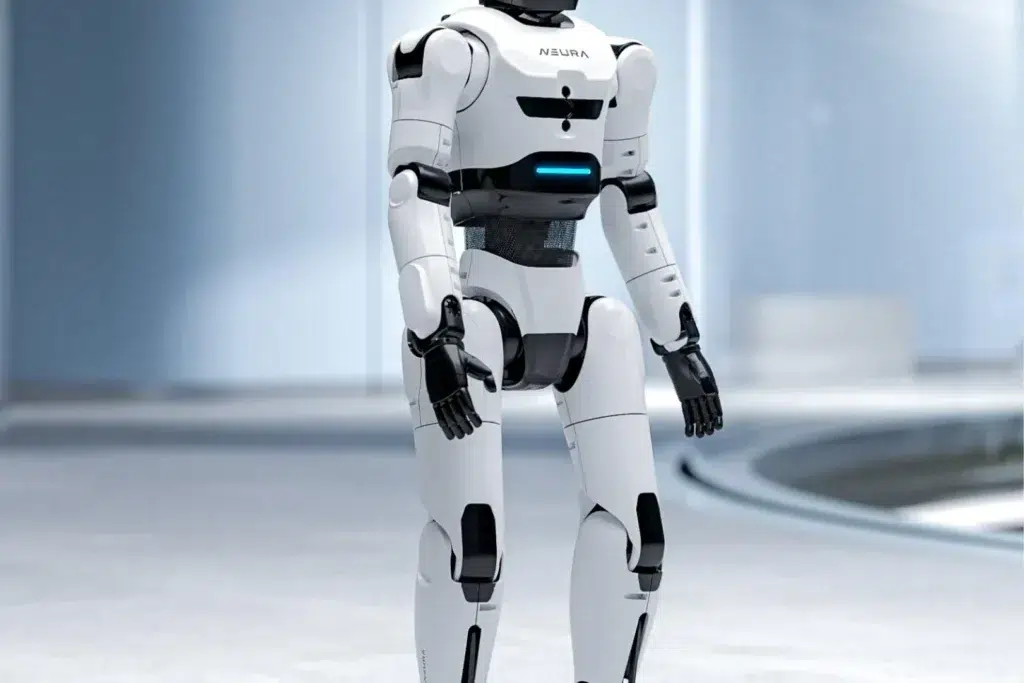
Neura also offers a Pro version at €29,999 excl. VAT. It exceeds the cap for this comparison and is therefore not included.
The 4NE1 Mini is sold through a reservation system. The manufacturer asks for €100, which is deducted from the final price and refundable at any time before the contract is signed. Availability is announced for 2026.
The 4NE1 Mini Standard holds a particular place in this selection: its public price is quoted directly in euros, but excluding VAT and shipping. It is not a final price including VAT.
The full-size 4NE1 sits in a different price bracket, with a German price of €98,000 excluding taxes and shipping, according to the manufacturer.
Available to order or pre-order only: what is the difference?
A public price does not always mean the same stage of commercial availability. Manufacturer catalogues, retailer offers, pre-orders and reservations are different situations.
| Model | Documented sales status | Known terms |
|---|---|---|
| Unitree R1 AIR and standard | Official catalogue prices and an R1 pre-order offer reported in the press | AliExpress pre-order with shipments announced from 30 June 2026 |
| Unitree G1 standard | Official catalogue price and offers from German retailers | Six retailers listed in the German survey of September 2026 |
| Neura 4NE1 Mini Standard | Reservation ahead of contract | €100 reservation, refundable before signature, availability announced for 2026 |
The G1 has sales offers listed by several German retailers. The R1 has a list price and a pre-order offer reported in the press. The 4NE1 Mini is sold through a reservation system that precedes the contract.
How to compare these humanoid robots: key criteria
A comparison based on price alone would automatically favour the Unitree R1 AIR. Yet, as eWeek points out in its market analysis, a robot’s value depends on the useful work it can do for the money spent.
Four criteria structure the comparison: documented use, hands and manipulation, stated autonomy, and warranty terms.
1. Use case and robot category
The Unitree R1 and G1 are walking humanoids. The R1-D, despite its lower price, is a dual-arm developer platform. eWeek explicitly separates it from walking robots such as the R1, G1, H2, 1X’s NEO and Figure 03.
This distinction shows why a particularly low price is not enough to put two machines in the same category. The market includes development platforms, industrial machines and general-purpose robots with different ambitions.
2. Hands and manipulation
Hands are one of the major technical cost items in humanoids. eWeek highlights the weight of motors, actuators and manipulation systems in the design of the most sophisticated machines.
In this selection, the best-documented case is the standard G1: three-finger hands are not included in its base configuration.
Price comparisons therefore need to account for the equipment actually included. A configuration without specialised hands and a version with additional manipulation capabilities do not represent the same hardware.
3. Stated autonomy
Autonomy is a key criterion for assessing a robot’s useful work. In eWeek’s analysis, it feeds directly into total cost of ownership, alongside integration, safety, maintenance and fleet management.
The level of human intervention needed during a task is also an economic factor. eWeek gives the example of a $20,000 robot that needs constant intervention and can end up costing more than a pricier machine able to cover a full shift.
4. Warranty and support
The warranty should be examined separately from the hardware price. It determines part of the after-sales coverage, while technical support contributes to the cost of use.
The market includes offers in which these services are built into the purchase price, as well as subscription models in which the provider keeps ownership of the robot in exchange for a recurring payment.
Why are some humanoid robots not in this comparison?
The €20,000 cap is not enough on its own for a model to qualify. It also needs a dated public price tied to an identifiable offer. Price targets, prices for used machines above the threshold and subscriptions are not treated as comparable purchase prices.
1X NEO price: $20,000 to buy or a monthly subscription
The NEO robot from 1X Technologies is offered in two formats, according to the catalogue checked on 19 October 2026.
- Early Access: $20,000 to buy, with a three-year warranty, premium support and priority delivery.
- Standard: $499 per month to use the robot on a subscription.
The Early Access purchase price is exactly $20,000, whereas this comparison only includes amounts strictly below the cap. The Standard subscription is not a purchase price.
The manufacturer requires a $200 deposit, presented as refundable. A full refund is available for up to 14 days after the invitation to order is sent, after which the deposit becomes non-refundable. The process amounts to a waiting list, not a firm order.
First deliveries are announced in the United States in 2026. NEO also has an Expert mode in which a 1X operator takes over remotely.
Tesla Optimus: no sale price published
Tesla has not published a sale price for Optimus. The only sourced figure is an estimate by Elon Musk of around $30,000, made in October 2024.
At Davos on 22 January 2026, Elon Musk placed sales to the public from the end of 2027, without giving a price. According to TechCrunch, he said on 21 October 2026 that Tesla could produce 20,000 Optimus per week by the end of 2027: a target, not a current capacity.
As of today, no official Tesla reservation has been identified for Optimus. The 2024 estimate is not a public retail price.
Booster T1 price: a research platform above the cap
Génération Robots, in Mérignac, offers a used demonstration Booster T1 Standard at €31,200 incl. VAT, or €26,000 excl. VAT. The original list price is €39,000 incl. VAT, with a displayed 20% discount and stock limited to a single unit.
This research platform runs on ROS 2 and comes in several configurations:
- Standard: 23 degrees of freedom.
- With grippers: 31 degrees of freedom.
- With dexterous hands: 41 degrees of freedom.
The Booster T1 exceeds the price threshold used here, even in this used offer.
Humanoid robot cost: the purchase price is only part of it
Price differences between humanoids come down in particular to their mechanical architecture, sensors, manipulation capabilities and the software resources needed to run them.
eWeek identifies several key cost items: motors and actuators, hands, depth cameras, LiDAR, force sensors, inertial measurement units, tactile sensors and microphones, as well as software, artificial intelligence, training, manufacturing and support.
For businesses, these components come on top of spending on safety, integration, data, maintenance and fleet management.
Goldman Sachs Research estimates cited by eWeek put the cost of manufacturing a humanoid in 2024 at between about $30,000 and $150,000 depending on sophistication, down from an earlier range of about $50,000 to $250,000. These 2024 production figures are not sale prices.
The growth of Robots-as-a-Service (RaaS) offers adds another way to pay for using these machines: the provider retains ownership and charges a recurring fee. 1X’s NEO Standard subscription is one example of this separation between purchase and use.
What we do not know yet
The available public prices make it possible to compare several models below the threshold, but commercial and technical information remains incomplete on several points.
- Prices in France: no official French price including VAT has been confirmed for the Unitree R1 and G1. Actual import and customs costs for France remain unknown.
- EDU versions: Unitree lists prices on request for the R1 EDU and G1 EDU, without publishing the amounts.
- Battery life and capabilities: comparable battery life for the four selected models, their detailed manipulation performance and their capacity for autonomous work are not documented in the available information.
- Warranty: the exact warranty periods and terms for the Unitree R1, G1 and Neura 4NE1 Mini Standard are not established here.
- Availability: actual availability in France, stock levels and current delivery times for the selected models are not confirmed. No French launch of the 1X NEO has been announced.
- Maintenance and after-sales service: servicing, repair and after-sales support costs have not been quantified.
- Manufacturing costs: no verified estimate of humanoid manufacturing costs in 2026 is available.
- Other models: sale prices for the Figure 03, Atlas, Digit 5 and most industrial humanoids are not public.
See also: Humanoid robot comparisons; Humanoid robot prices; Buying a humanoid robot in France; Unitree R1: models and prices; Unitree G1: specifications and price; 1X Technologies: humanoid robots and commercial offers.
The newsletter
Get the latest on humanoid robots
A selection of announcements, prices and demonstrations, with no advertising. Unsubscribe in one click.