
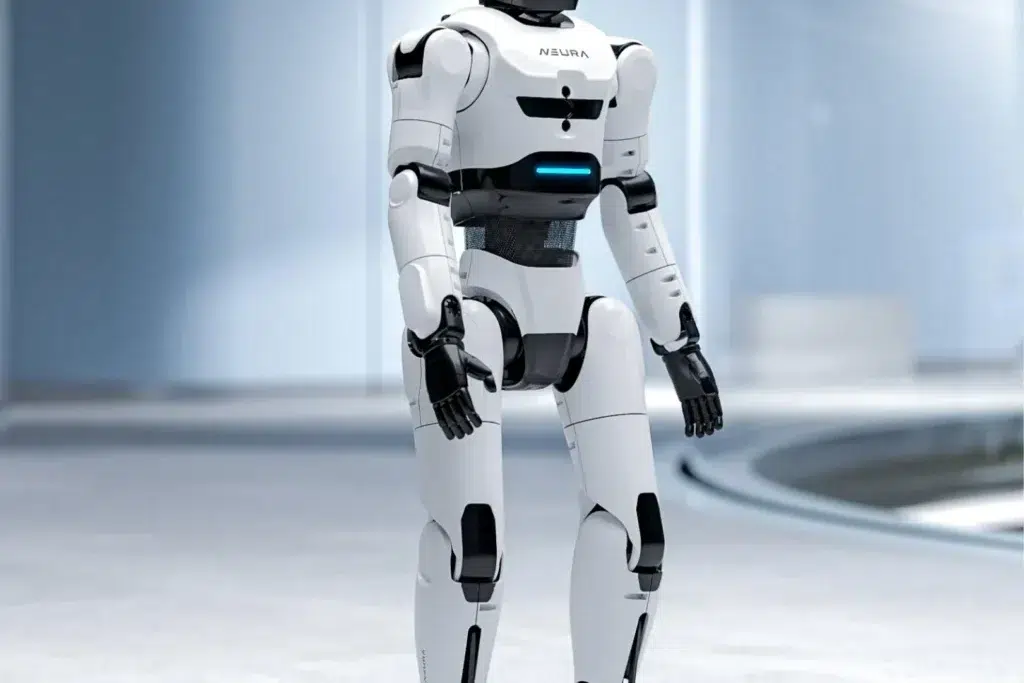
Humanoid robots built for teaching and research cover very different needs, from introductory programming to developing locomotion and manipulation systems. The available platforms differ in price, software interfaces, hardware configurations and what they offer developers. Models from Unitree, Neura Robotics, Booster Robotics and Faraday Future illustrate these different approaches.
Among the uses of humanoid robots, education covers both programming activities and laboratory experiments. Some platforms offer open interfaces and simulation environments, while others focus on block-based programming or advanced hardware configurations.
Which humanoid robots suit teaching and research?
Five models from four manufacturers allow a comparison across several equipment levels. The Unitree R1 is a developer platform offered in several versions, including an EDU version. The Neura 4NE1 Mini combines developer interfaces with interaction features. The Booster T1 focuses on research, with several joint configurations. At Faraday Future, the FF Nova and the Nova Mini occupy two separate segments: one aimed at development, the other at introductory programming.
Their prices do not all cover the same scope. Some are quoted excluding taxes and shipping, while others apply to a specific configuration or a demonstration unit. Software features and included accessories also vary between versions.
Educational humanoid robot prices and specs compared (21 October 2026)
| Robot and manufacturer | Published price | Configuration and hardware | Software and development | Documented positioning |
|---|---|---|---|---|
| Unitree R1 | AIR: $4,900; standard: $5,900, excl. taxes and shipping. EDU on request. | Battery life of about 1 hour; non-grasping hands on the base version. | Open joint and sensor interfaces; compatible with common simulation platforms; advanced development on EDU. | Developers and laboratories. |
| Neura 4NE1 Mini | Standard: €19,999 excl. VAT; Pro: €29,999 excl. VAT, excl. shipping. | Pro with 12-DoF articulated hands; Wi-Fi 6 and Ethernet. | Neuraverse, Python SDK, ROS 2; C++ SDK, digital twin and teleoperation on Pro. | Classrooms, laboratories and prototyping. |
| Booster T1 | Used demonstration unit: €26,000 excl. VAT, or €31,200 incl. VAT; list price: €39,000 incl. VAT, according to Génération Robots. | 23, 31 or 41 DoF depending on configuration; NVIDIA AGX Orin 200 TOPS. | Open-source platform compatible with ROS 2. | Robotics research and development. |
| Faraday Future FF Nova | $2,490; additional developer software pack at $390. | 49.7 cm; 2.8 kg; 20 DoF. | ROS 2; NVIDIA Isaac for simulation training. | Invited developers and schools. |
| Faraday Future Nova Mini | $299; 16-session online course at $499, with a voucher valid toward the robot. | Detailed hardware configuration not disclosed. | Block-based programming and online courses. | Introduction for ages 8 and up. |
The amounts reflect the offers and information published as of 21 October 2026. Unitree and Faraday Future prices are in dollars, Neura prices are in euros excluding VAT, and Booster T1 prices are those reported by its French retailer. The table shows the specifications announced by the manufacturers and, for Booster, the sales information from Génération Robots.
Unitree R1 and G1 EDU: two developer platforms
The Unitree R1 is presented by its manufacturer as a platform for developers and laboratories. The range includes the R1 AIR, the standard R1 and an EDU version that supports advanced development.

Its open interfaces give access to the joints and sensors. Compatibility with common simulation platforms means the robot can be integrated into development and testing environments. The manufacturer quotes a battery life of about one hour.
The base version has non-grasping hands. This matters for manipulation experiments, as it separates the base hardware capabilities from the configurations intended for more advanced development.
Unitree announces a six-month warranty for the R1 AIR, eight months for the standard R1 and twelve months for the R1 EDU. The manufacturer presents the R1 as a civilian robot and stresses the need to keep a safe distance.
Unitree G1 EDU: onboard computing and optional hands
The Unitree G1 EDU is another of the manufacturer’s options for secondary development. This version includes an Orin computing module and can be fitted with optional Dex3-1 hands.
Its announced warranty runs to 18 months, compared with twelve months for the R1 EDU. The G1 EDU is priced on request.
The two platforms differ mainly in their configurations and warranties. The Unitree catalogue brings together these different families of humanoid robots.
Neura 4NE1 Mini price: Standard and Pro versions for labs
The Neura 4NE1 Mini is developed by German manufacturer Neura Robotics. It is explicitly aimed at classrooms, laboratories and prototyping spaces. Two configurations have been announced: Standard and Pro.
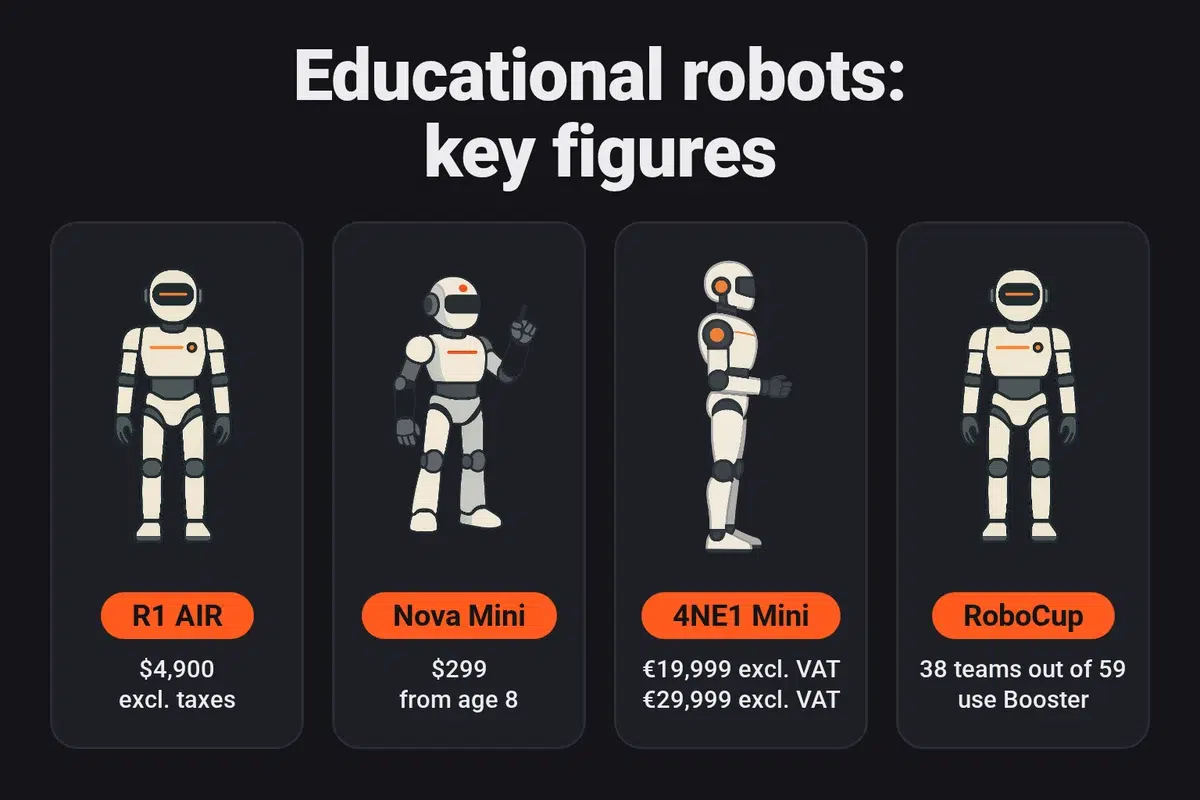
The Standard version, listed at €19,999 excl. VAT and shipping, includes voice interaction, Neuraverse and developer interfaces. The robot supports Wi-Fi 6, Ethernet, a Python SDK and ROS 2.
The Pro version, announced at €29,999 excl. VAT and shipping, adds several tools for advanced development:
- Articulated hands with 12 degrees of freedom.
- A C++ SDK.
- A digital twin.
- Teleoperation features.
- NEURA Gym.
This difference in configuration gives the Pro version additional manipulation, simulation and control capabilities.
Neura takes a €100 reservation, refundable before signing and deducted from the price. The 4NE1 Mini is announced for availability in 2026.
On mobility, the manufacturer mentions flat and uneven surfaces. Stair climbing is still in development. Hardware adjustments may still be made before the final version.
Booster T1: an open-source research platform with several configurations
The Booster T1, developed by Booster Robotics, is an open-source research platform compatible with ROS 2. In France, it is distributed by Génération Robots, based in Mérignac.
The robot carries an NVIDIA AGX Orin computing platform rated at 200 TOPS. Three joint configurations are offered, with significant differences for manipulation experiments.
| Booster T1 configuration | Degrees of freedom | Distinctive equipment |
|---|---|---|
| Standard | 23 DoF | Standard configuration |
| With grippers | 31 DoF | Manipulation grippers |
| With dexterous hands | 41 DoF | Dexterous hands |
The retailer quotes two hours of battery life when walking and four hours when standing. These are commercial figures announced by Génération Robots, not measurements from an independent test.
Booster T1 price, after-sales service and distribution in France
Génération Robots lists a used demonstration unit at €31,200 incl. VAT, or €26,000 excl. VAT. The stated list price is €39,000 incl. VAT. The demonstration offer covers a single unit.
The retailer promises a first after-sales response within 24 business hours. Its product page also displays a CE mark.
For French public institutions, Génération Robots accepts payment by administrative mandate. This option is one of the practical aspects specific to the Booster T1’s distribution in France.
Booster T1 in robotics competitions
Booster Robotics says that 38 of the 59 teams taking part in RoboCup 2026 use its robots. This figure, reported in a published article, shows their presence in this robotics competition setting.
RoboCup is a documented use case here, separate from classroom applications and laboratory experiments.
Faraday Future FF Nova and Nova Mini: two learning levels
Faraday Future offers two robots with different formats and positioning. The FF Nova is aimed in particular at developers, while the Nova Mini is presented as a programming platform for ages eight and up.
FF Nova price and specs: a compact ROS 2 humanoid
The FF Nova is 49.7 cm tall, weighs 2.8 kg and has 20 degrees of freedom. Its announced price is $2,490.
The robot is compatible with ROS 2 and has a developer software pack sold separately for $390. Faraday Future also mentions NVIDIA Isaac for simulation training.
The manufacturer refers to 100 units intended for invited developers and schools, 20 of which are ready to ship. This first allocation therefore concerns an identified group of recipients.
Nova Mini price: block-based programming and an online course
The Nova Mini is announced at $299. Faraday Future targets it at children aged eight and over and highlights block-based programming.
A 16-session online course is offered at $499. This offer includes a voucher valid toward the robot.
The two products therefore reflect different approaches. The Nova has interfaces for development and simulation, while the Nova Mini comes with a block-based programming course.
PhoneBot: an open-source research robot built around a smartphone
The PhoneBot, developed at UCLA, represents another approach to the educational and experimental humanoid robot. It is an open-source research project built around an Android smartphone.
The robot is 48 cm tall and weighs 1.8 kg. Its design uses 13 motors and has no arms. Its documented movement is walking on flat ground.
The cost of parts is estimated at about $400, excluding the smartphone. This figure covers the project’s components, not the price of an assembled robot.
The work is presented in an arXiv preprint. The PhoneBot is not a commercial product and is not distributed in France.
This sets it apart from the manufacturers’ platforms: its documented value lies in an open experimental architecture with an Android smartphone at the centre of the design.
How to compare educational humanoid robot platforms
Price is a first criterion, but the models also differ in software architecture, degrees of freedom, manipulation hardware and distribution terms.
1. Programming interfaces and SDKs
Development environments vary considerably between manufacturers:
- Unitree R1: access to joint and sensor interfaces, with compatibility with common simulation platforms.
- Neura 4NE1 Mini: Python SDK, ROS 2 and, on the Pro version, C++ SDK, digital twin and teleoperation.
- Booster T1: open-source platform compatible with ROS 2.
- FF Nova: ROS 2, additional developer pack and NVIDIA Isaac for simulation.
- Nova Mini: block-based programming combined with an online course.
These interfaces correspond to distinct activities, from block-based programming to robot control and simulator experiments.
2. Manipulation configurations and degrees of freedom
The number of degrees of freedom and the type of hands are key specifications when comparing hardware.
The FF Nova has 20 DoF. The Booster T1 offers 23 DoF in the Standard configuration, 31 with grippers and 41 with dexterous hands. The Neura 4NE1 Mini Pro has 12-DoF articulated hands. The Unitree G1 EDU offers optional Dex3-1 hands, while the base R1 has non-grasping hands.
These figures must be read within their respective scope: Neura’s 12 DoF refer to its hands, whereas the 20, 23, 31 and 41 DoF published for the other models describe their overall joint configurations.
3. Onboard computing and simulation
The Booster T1 uses an NVIDIA AGX Orin rated at 200 TOPS. The Unitree G1 EDU also includes an Orin computing module.
For simulation, the Neura 4NE1 Mini Pro has a digital twin, while the FF Nova relies on NVIDIA Isaac. The Unitree R1 is announced as compatible with common simulation platforms.
A simulation environment and an onboard computing module are two different characteristics of a developer platform.
4. Battery life and mobility
Unitree quotes about one hour of battery life for the R1. Génération Robots gives two hours walking and four hours standing for the Booster T1.
The Neura 4NE1 Mini is presented for flat and uneven surfaces, with stair climbing still in development. The PhoneBot’s documented walking is on flat ground.
These characteristics help match the robots to the movement conditions planned for experiments.
5. Cost and purchase terms
The published amounts fall into several categories: manufacturer prices in dollars for Unitree and Faraday Future, euro prices excluding VAT for Neura, and retailer prices including or excluding VAT for Booster.
The R1 EDU version and the G1 EDU are available on request. The Neura 4NE1 Mini has two public prices depending on its configuration. For Booster, the available figures include a list price and an offer on a used demonstration unit.
Warranty and service terms are also practical criteria. Unitree announces six, eight, twelve or eighteen months depending on the model. Génération Robots states a first after-sales response within 24 business hours.
The humanoid robot price guide looks in more detail at the differences between base prices, configurations and commercial offers.
Using humanoid robots in schools and labs: deployment and safety
Using a humanoid robot in an educational institution or laboratory means taking into account the experiments being run and the operating conditions of the hardware.
Safety measures must be adapted to the experiments, in line with the wording published about the Booster T1. Unitree also specifies a safe distance when using the R1, which it presents as a civilian robot.
Distribution terms can also play a part in organising a project. In France, Génération Robots accepts administrative mandates from public institutions and offers after-sales service with a first response within 24 business hours.
The guide to buying a humanoid robot in France covers questions about sales channels and the purchasing process.
Other educational robotics initiatives
Beyond the models compared here, educational programmes are being built around humanoid robotics. In Vietnam, AgiBot is involved in an educational programme with NIC and in a robot rental offering.
This initiative illustrates another way of accessing robotic platforms, separate from the commercial offers and open-source projects described above.
UCLA’s work on the PhoneBot also shows that research can rely on an experimental architecture built around components and a smartphone, rather than on a complete commercial humanoid.
What we do not know yet
Several pieces of information remain undisclosed or unconfirmed, which prevents a complete comparison of these platforms in the French context.
- Availability in France: sales, availability and shipping terms in France for the Neura 4NE1 Mini and the Faraday Future FF Nova have not been specified. Faraday Future gives no indication for Europe.
- French prices for Unitree: the prices incl. VAT applicable in France for the R1 and G1 EDU have not been disclosed.
- Licences and updates: detailed terms for software licensing, maintenance and updates on these platforms have not been specified.
- User feedback: teaching outcomes and documented feedback from institutions using these models are not available in the published information.
- European compliance: CE compliance for robots not sold through a French retailer has not been established. For the Booster T1, the retailer displays a CE mark on its product page.
See also: uses of humanoid robots, the Unitree range, the Unitree G1 page, the Unitree R1 page, Figure AI robots, Boston Dynamics robots, humanoid robot prices and buying a humanoid robot in France.
The newsletter
Get the latest on humanoid robots
A selection of announcements, prices and demonstrations, with no advertising. Unsubscribe in one click.