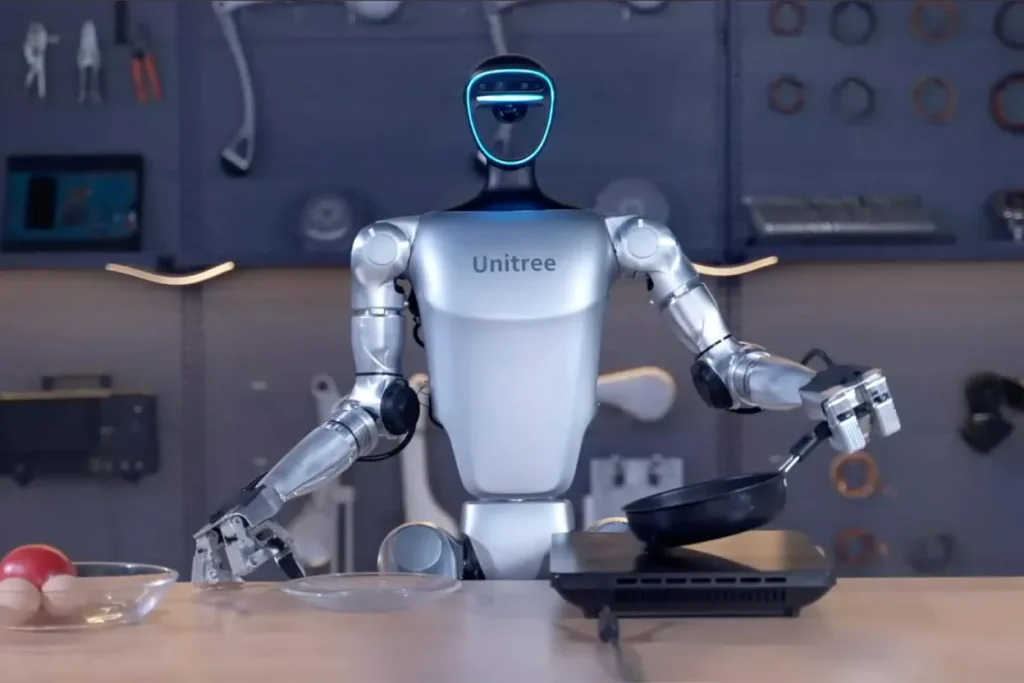
At Unitree, robot assembly is still mainly done by hand, despite a demonstration of G1 robots working on a production line. A visit to the Hangzhou factory and the manufacturer’s financial data shed light on the economic limits of automation.
Josef Chen, founder of Kaikaku and an investor in several US hardware startups, published his observations on 5 November after visiting Unitree’s factory in Hangzhou, China. In the building dedicated to actuators, he saw one or two new automated lines, while the rest of the shop floor relied on operators working winding machines. Photography was not allowed inside the factory.
The G1 humanoid assembly demo is still a pilot project
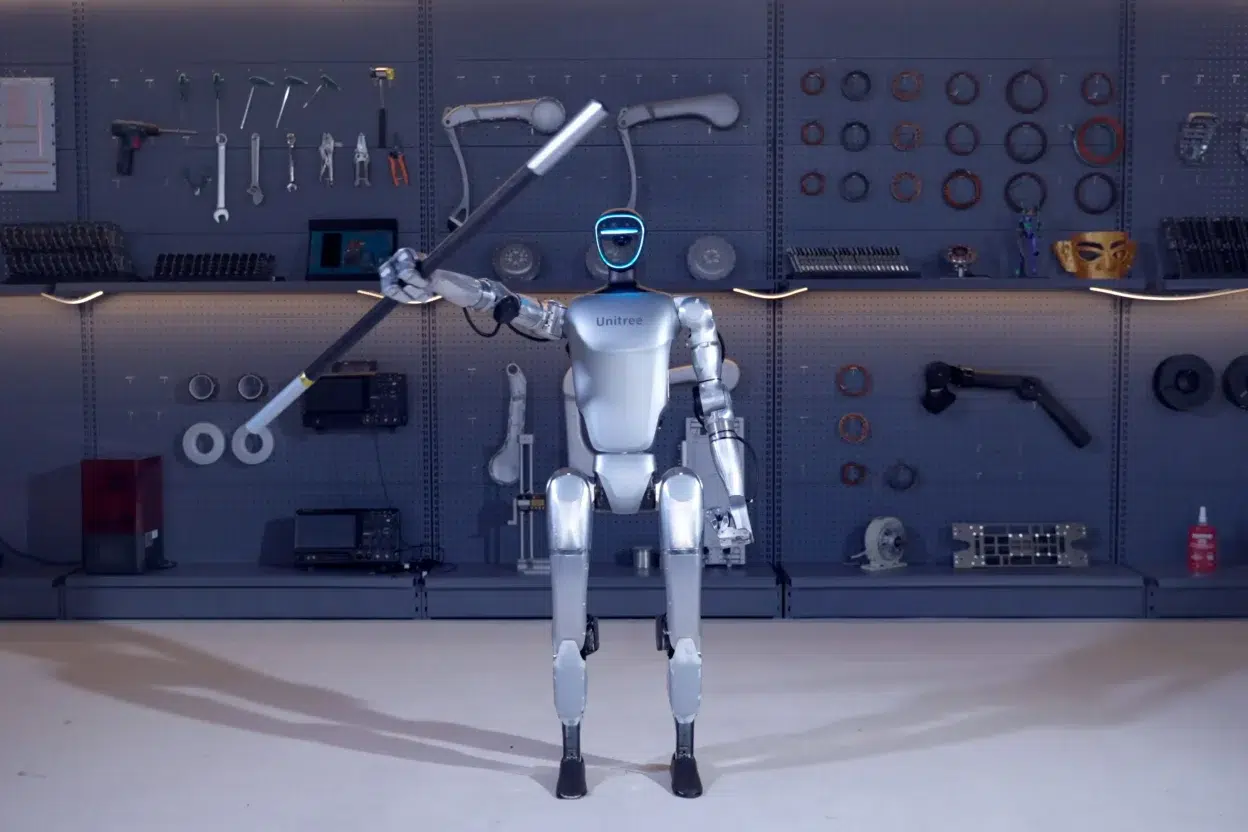
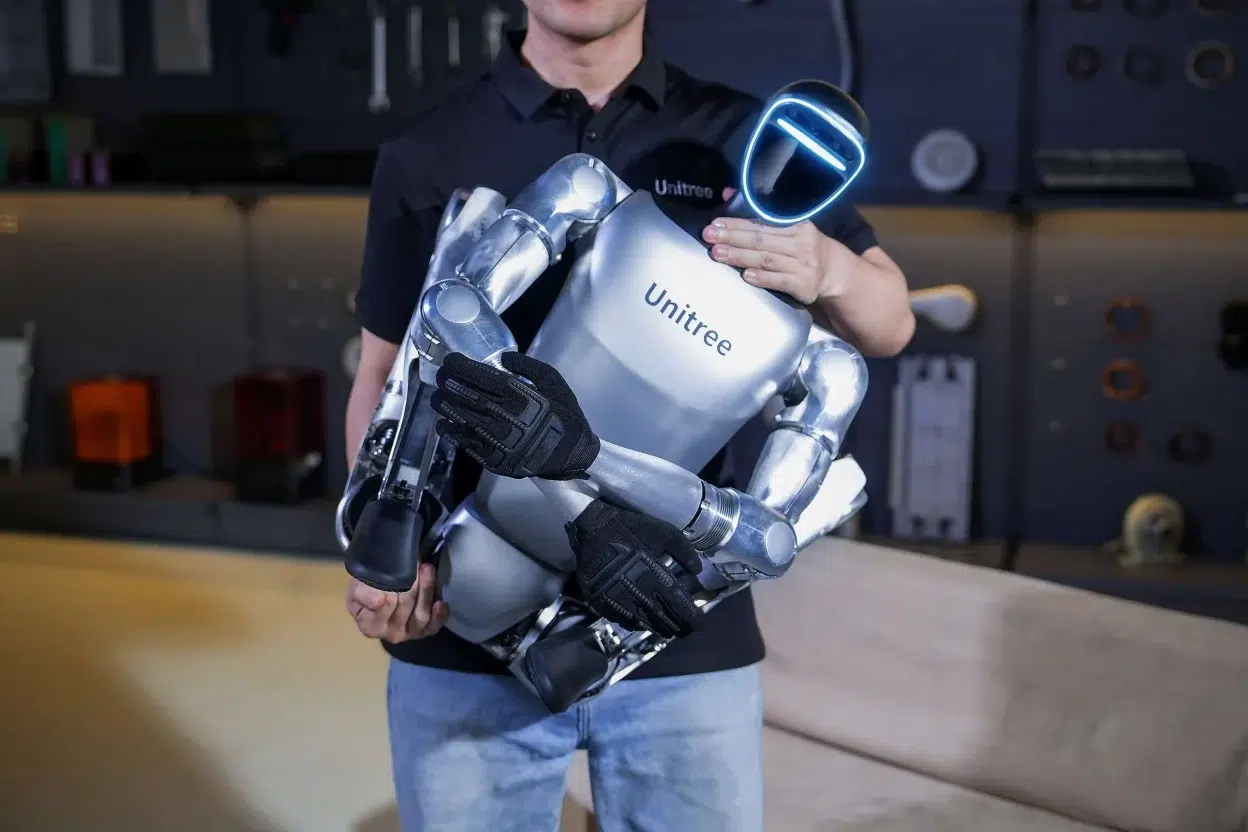
In February, Unitree released a video showing G1 humanoid robots assembling parts on its own production line. The robots were running the UnifoLM-X1-0 model. The manufacturer presented the footage as a real deployment, and the video passed 28 million views.
Unitree’s financial prospectus makes an important distinction: the humanoids’ work on the line is described as a pilot project, while the assembly of the company’s robots is described as mainly manual.
The demonstration therefore shows an industrial application of the G1, but it does not reflect how Unitree’s manufacturing lines generally operate.
How Unitree built nearly 32,000 robots with little industrial equipment
The figures cited by Josef Chen come from Unitree’s prospectus and from its 20 March response to questions from the Shanghai Stock Exchange.
At the end of 2025, the book value of all of Unitree’s machinery stood at about $1.7 million. That same year, the manufacturer built nearly 32,000 robots, around 26,000 of them quadrupeds.
Measured against that annual output, the book value of the equipment works out to about $50 per robot, according to Chen’s calculation. This ratio compares the value of the machines with the volume produced. It is not their operating cost per unit.
Unitree’s breakdown of production costs in 2025 also explains why it continues to rely on manual assembly:
- 81.7% for materials and components.
- 10.2% for manufacturing overheads.
- 8.1% for direct labour, including subcontracted assemblers.
According to the manufacturer’s financial documents, the labour needed to produce one robot has been roughly halved since 2023. Unitree attributes this to higher volumes, standardised procedures and the experience its teams have gained.
Unitree’s new motor line aims to cut labour by 57%
Unitree expects its new motor production line to cut the labour needed per motor by 57%. However, according to the manufacturer’s estimates, this automation would reduce the manufacturing cost of the robot model concerned by only 1.7%.
Annual product line changes also make it harder to invest in specialised equipment. A machine designed to assemble a particular model can become useless once that model’s design changes.
Unitree therefore gives priority to automating joint modules, components shared by several of its robots. This approach lets the same equipment serve more products.
Who buys Unitree humanoids: mostly research and education
At the WRC in August, Unitree CEO Wang Xingxing said humanoids were not yet ready for large-scale industrial deployment.
The manufacturer’s sales data reflect this. In the first nine months of 2025, research and education accounted for about 75% of Unitree’s humanoid revenue.
Factories and other industrial applications made up less than 5% of that revenue. In the sales category labelled industrial, at least half of the revenue came from robots used for guided tours.
These figures separate demonstrations of robots on assembly lines from their actual commercial use in factories.
Would US labour costs make robot factory automation pay off?
Josef Chen estimates that an hour of factory work in the United States costs about 7.5 times as much as in China. Applying US wages to Unitree’s cost structure, labour would account for about 40% of production spending, according to his calculation.
Under that assumption, the automated motor line that would cut the cost of a robot by 1.7% in Hangzhou would save about 9% in the United States. Chen therefore estimates that such equipment could be worth five to six times more to a US manufacturer.
This gap is the core of his analysis: Western makers of industrial machinery could find a market in automating robot production lines, even if Chinese manufacturers keep favouring certain manual operations.
How US rules push robot makers toward local production
The US regulatory context also plays a part in the outlook Chen describes. In July, the FCC stopped approving new foreign-made humanoids and quadruped robots unless they are produced in the United States with more than 65% US components by value. That threshold is set to rise to 75% from 2029.
From August 2027, drones funded by the Pentagon will also have to use motor stators wound outside China.
In a statement on 28 October, the White House highlighted US dependence on foreign imports for most categories of robots and industrial machinery.
These measures bear directly on where robots and their components are manufactured, including motors and the equipment needed to assemble them.