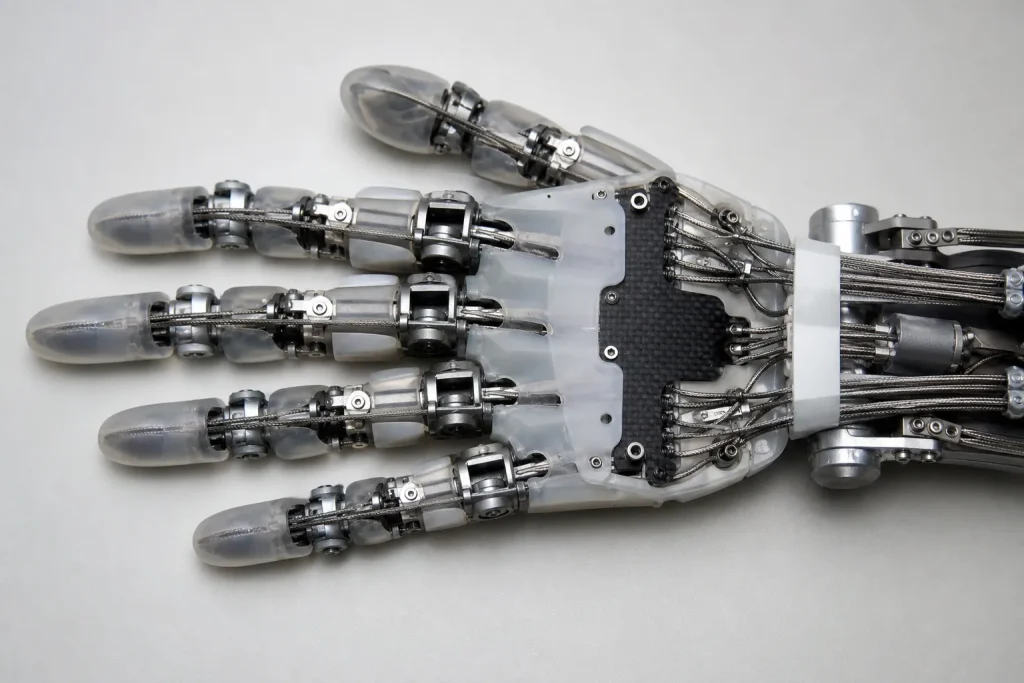
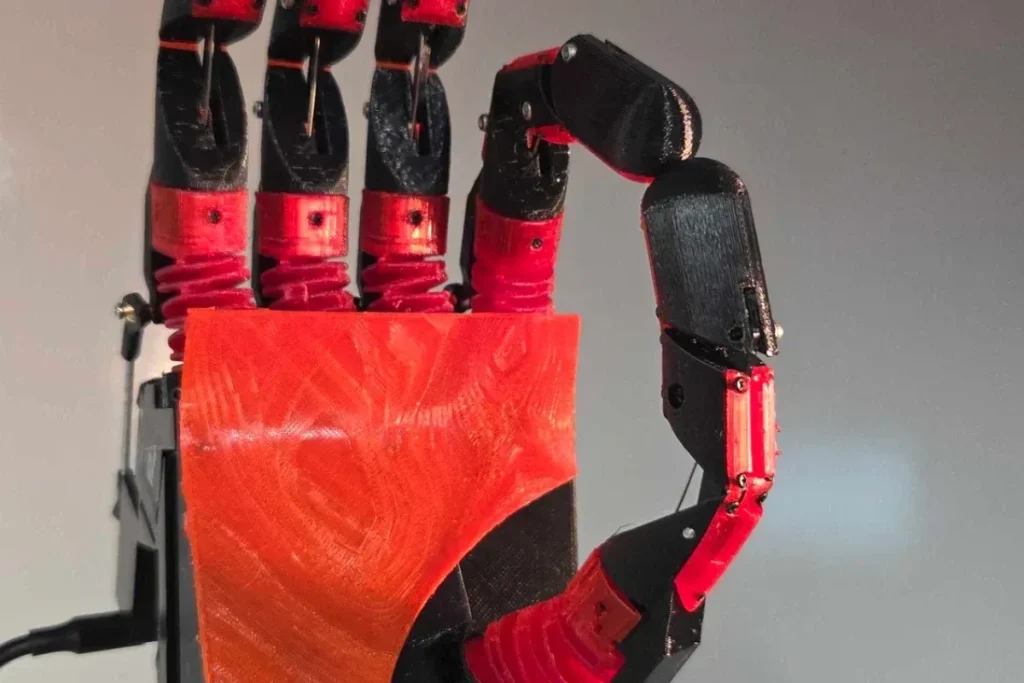
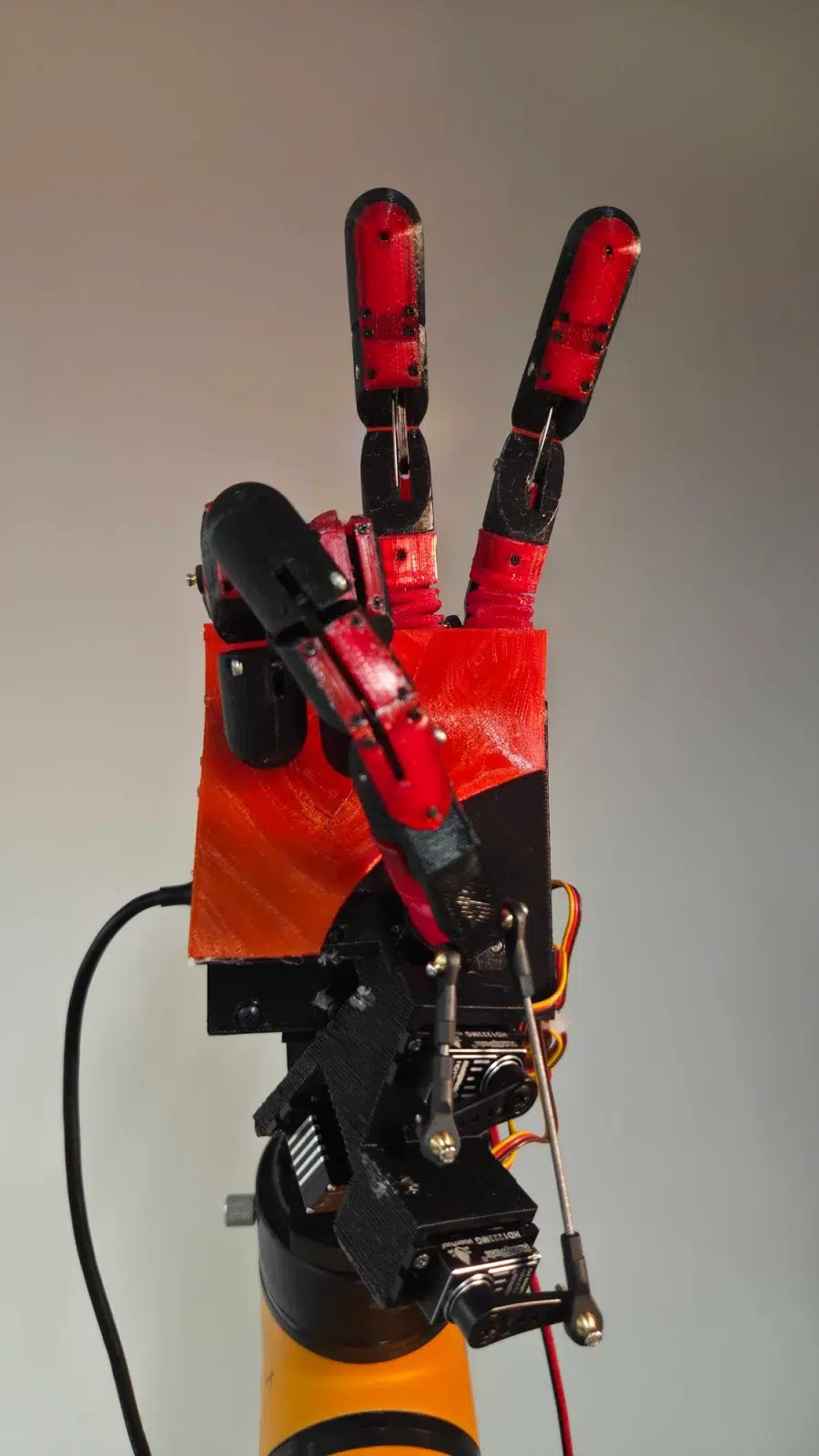
Researchers at the New Jersey Institute of Technology have developed PHD-Hand, a five-fingered robotic hand that can be printed on a consumer 3D printer. Its mechanism relies on rigid linkages rather than cables, and its components cost less than $650.
PHD-Hand is a humanoid robotics research project designed by Neel Adwani, a PhD student in electrical and computer engineering at the New Jersey Institute of Technology (NJIT), with Muhaiminul Islam Akash, Saffia Ouali and Ethan Liu, under the supervision of Professor Cong Wang. Their paper, titled “PHD-Hand: A Printable Humanoid Dexterous Hand with Linkage-Driven 3-DOA Digits”, has been accepted at the IEEE-RAS Humanoids 2026 conference, held from 6 to 9 December 2026 in Santa Clara.
Rigid linkages instead of cables in all five fingers
What sets PHD-Hand apart is its actuation system. Many low-cost robotic hands use tendons or cables, but PHD-Hand’s fingers are driven entirely by rigid mechanical linkages.
Tendon systems allow the motors to sit outside the fingers, but their cables need regular maintenance. They can stretch, slip and require tension adjustments.
Neel Adwani says he set out to achieve dexterity close to that of a human hand without this maintenance. According to the researcher, the first results with rigid linkages point in that direction.
Each PHD-Hand finger has three active degrees of actuation. The researchers use this term rather than three independent degrees of freedom because two of the joints are mechanically coupled.
At the base of the finger, a two-axis flexure joint printed in TPU allows flexion and sideways spreading. Two servos control its movements through rigid rods and four ball joints.
A third servo drives the two upper joints at the same time. A 0.6 mm spring stainless steel rod runs through the base joint and connects to a crossed four-bar mechanism.
This arrangement sets a flexion ratio of 0.77 between the two upper joints. The authors compare this value with the 0.75 to 0.8 range observed for the same coupling in human fingers.
Printed on a consumer 3D printer
The researchers designed PHD-Hand to be built with an inexpensive 3D printer, with no industrial machining needed for the printed parts.
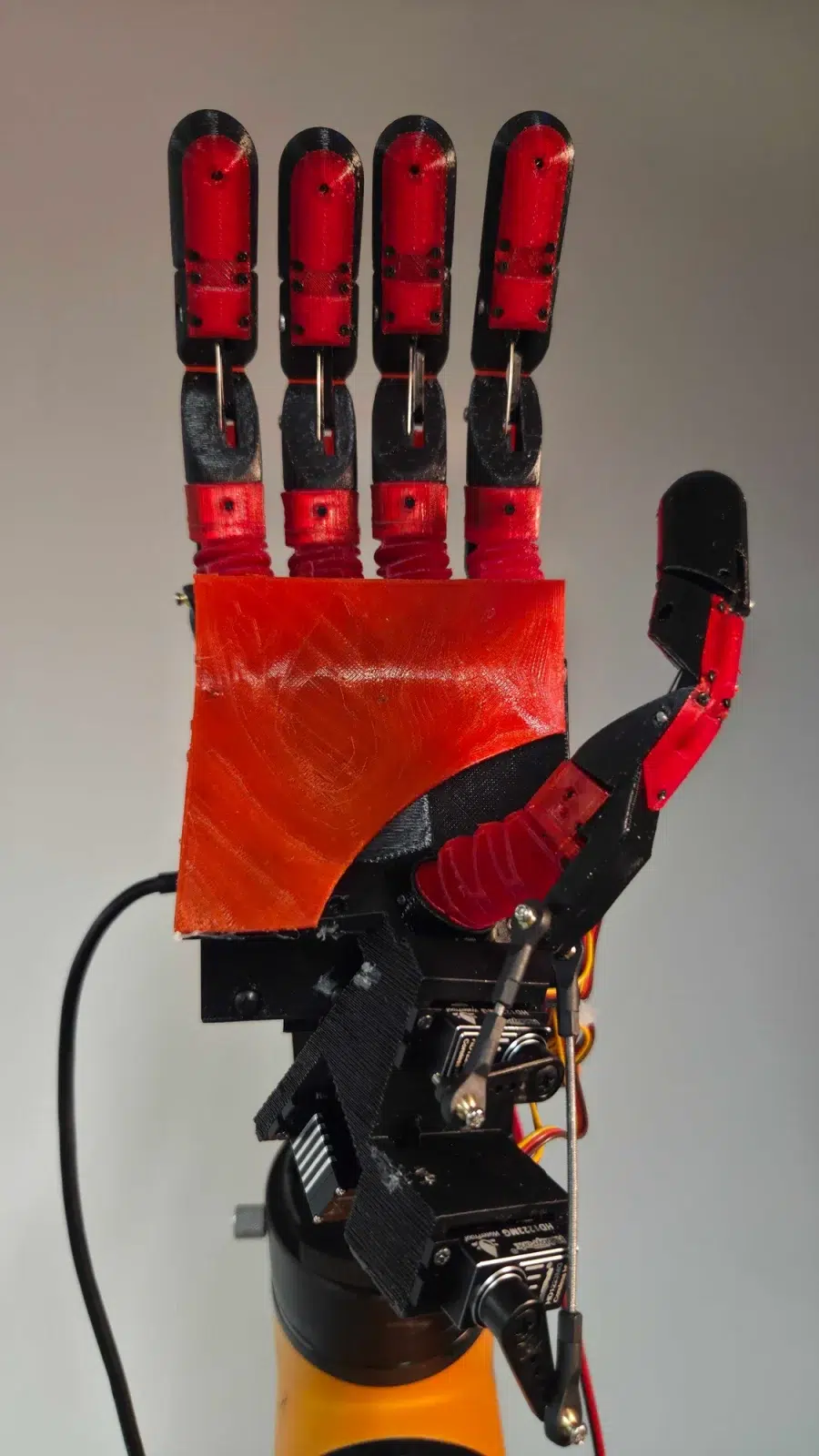
The phalanges are made of PETG or TPU, while the flexure joints are printed in TPU 95A. The team gives the following print settings:
- 0.4 mm nozzle.
- 0.15 mm layer height.
- 15% infill.
- Printed without supports.
Each finger consists of 18 printed or off-the-shelf parts. The authors compare this design with a rigid-linkage robotic hand presented by Kim and colleagues in Nature Communications in 2021, which had more than 27 parts per finger and required industrial machining.
15 servos for a 570 g hand
PHD-Hand uses 15 HobbyPark HD1223MG servos, three per finger. These coreless hobby servos are rated at a nominal torque of 12 kg·cm.
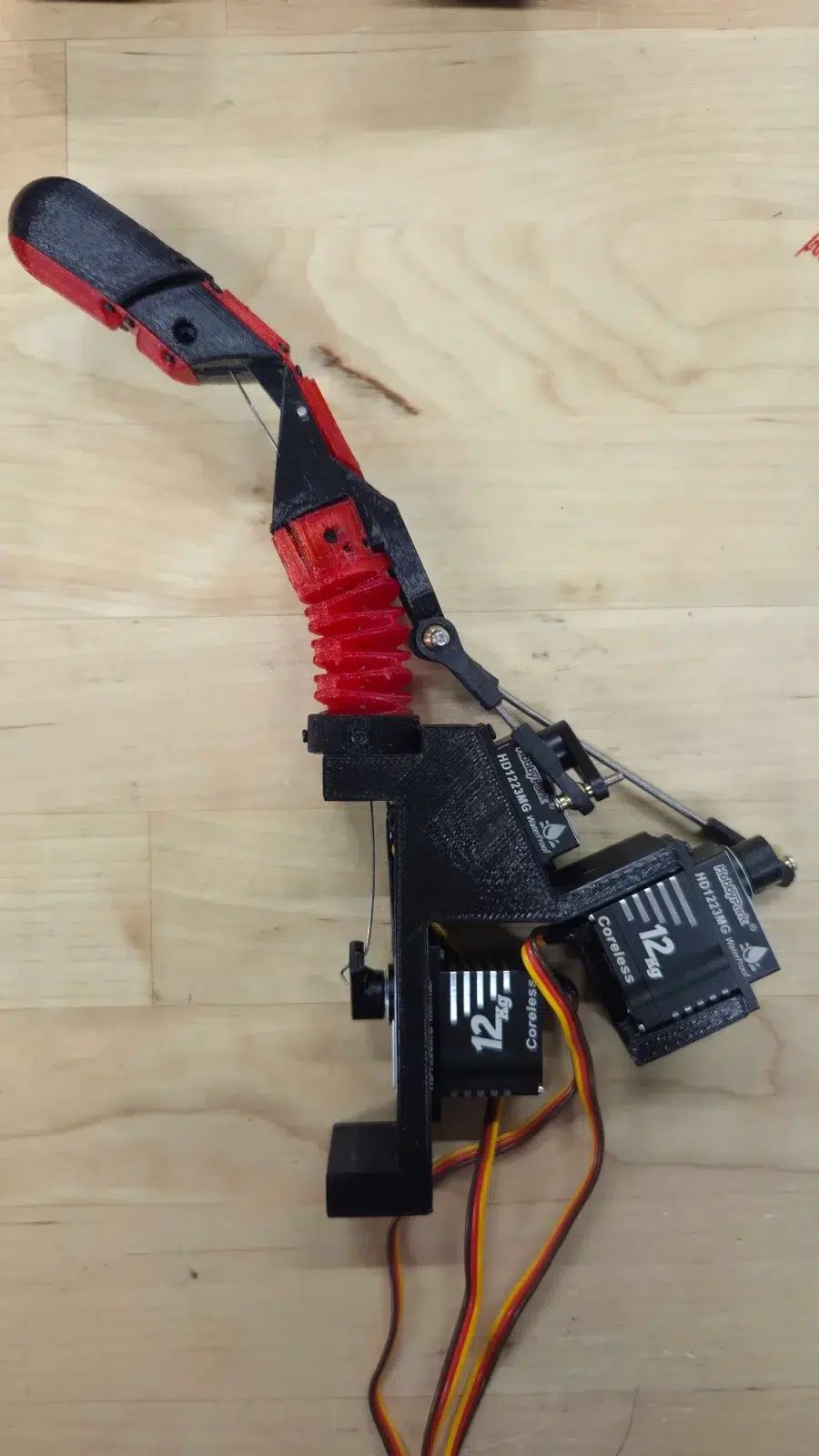
The system is run by a Pololu Mini Maestro 18 controller, which commands all 15 servos.
The complete hand weighs 570 g and measures 200 mm from the wrist to the fingertips. According to the researchers, its dimensions are close to those of an adult man’s hand.
For comparison, the authors cite the Linkerbot L20, a commercial robotic hand that measures about 225 mm. PHD-Hand is therefore slightly smaller than that model.
How much does PHD-Hand cost to build? Under $650 in parts
According to Neel Adwani, the components needed to build a complete hand cost less than $650. This figure covers the servos, the controller, the printing filament and the steel rods.
This is the stated parts cost of the prototype developed at NJIT, not the selling price of a commercial robotic hand.
The team also plans to release the design files and control software as open source, aiming for roughly one month after Neel Adwani’s statements.
Grasp tests, with further measurements planned
The researchers tested PHD-Hand against the Feix grasp taxonomy, a standard classification of the different ways of grasping objects.
Neel Adwani plans to present fingertip force measurements and the load the hand can hold in a future scientific paper. These data will add to the mechanical specifications published so far in the work on PHD-Hand.