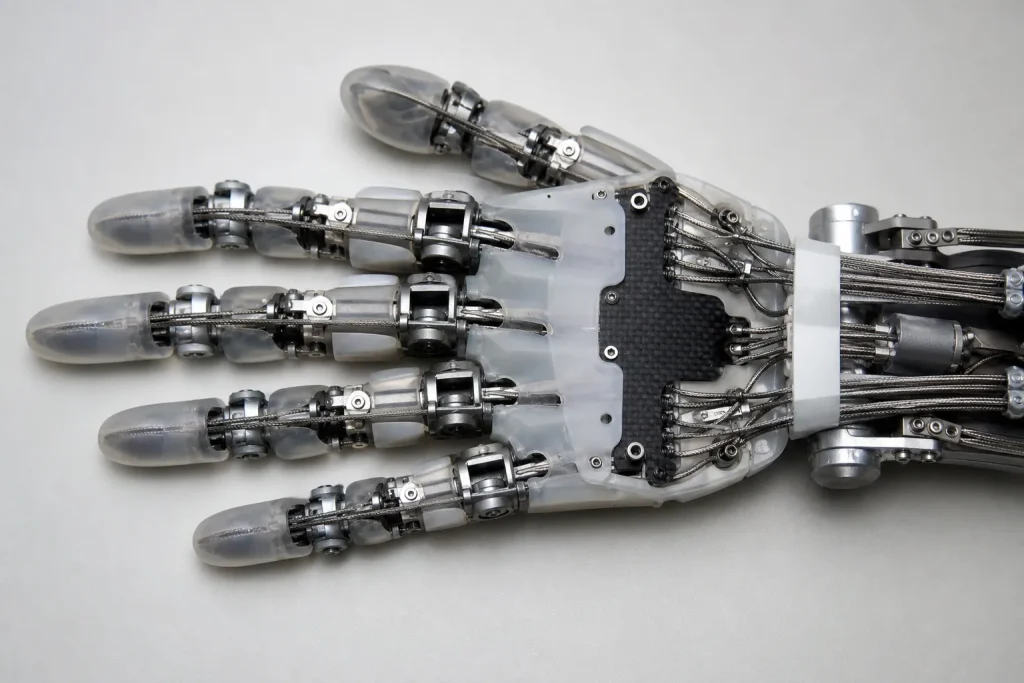
On 22 October 2026, Samsung Electronics published a US patent application for a robotic hand inspired by human tendons. Its mechanism combines cables, pulleys and springs to coordinate the finger joints with a single actuator per finger.
The application, published as US 2026/0326284 A1 under the title “Finger, Hand and Robot Apparatus Including Thereof”, describes an architecture for object manipulation by robots. It was filed in the United States on 7 May 2026 and claims priority from a South Korean application dated 22 April 2025. The named inventors are Donghyun Kim and Hyunggon Shin.
How Samsung’s cable-and-pulley finger mimics human tendons
The principle developed by Samsung Electronics mechanically reproduces the way tendons work in the human hand. Instead of fitting a separate motor to each joint, the manufacturer proposes coordinating several joints of a finger from a single actuator.
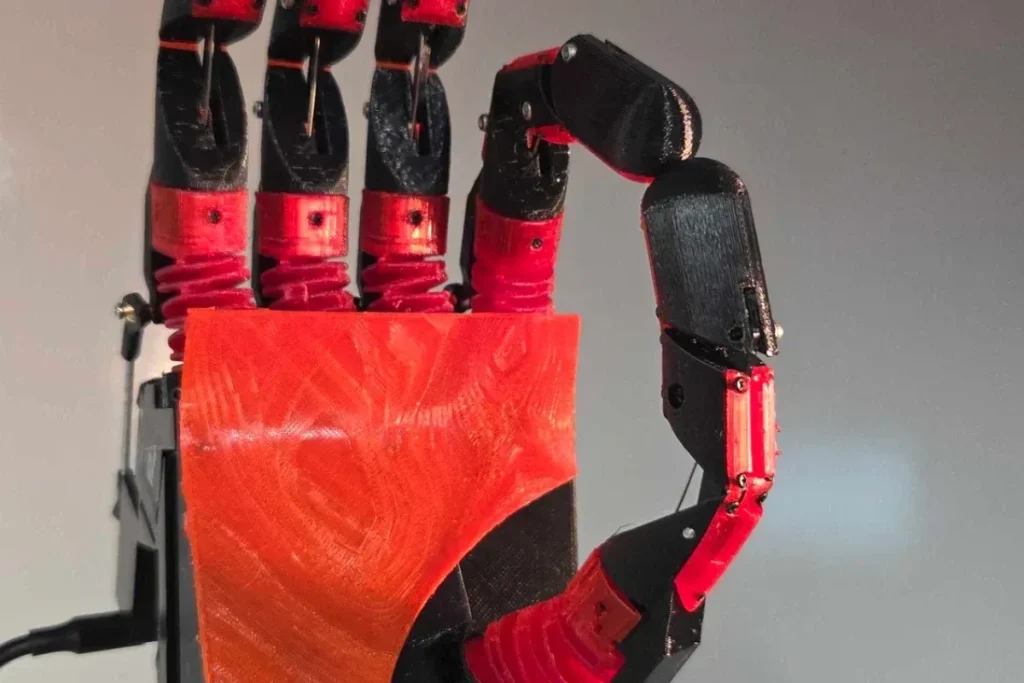
Each robotic finger comprises several articulated frames, rotation axes, an actuator and pulleys linked by cables. The motor’s movement changes the effective length of the cables, causing the joints to flex or extend.
When the actuator turns in one direction, the extension cable shortens and the joints straighten. In the opposite direction, the flexion cable shortens and the finger curls.
The aim of this architecture is to reduce the number of motors needed inside the fingers, and their weight, while keeping coordinated joint movements.
Springs that help the fingers respond to contact with objects
Samsung Electronics combines two types of pulleys in its patent application: active pulleys, which help control the movements, and passive pulleys, which are part of a return mechanism.

The passive pulleys are connected by separate cables. A spring module applies a return force to the joints when an external load moves them.
This system is designed to let the fingers return to their initial position after being deformed by an external force. It also allows joint movements to be adjusted mechanically when the hand comes into contact with an object.
The design therefore seeks to combine motor-driven fingers with a mechanical response to the forces exerted during manipulation.
Actuators in the palm drive each finger
The patent also describes a complete robotic hand architecture. Several actuators are installed inside the palm and drive the different fingers independently.

Samsung Electronics plans to combine finger modules with a thumb module to achieve different grip configurations.
This layout could be used in humanoid robots or industrial service robots that have to handle objects of varied shapes, sizes and materials.
For industrial applications, the goal is notably to enable stable manipulation of parts and tools, beyond simply grasping them.
Still a patent application, not a product
Cable-driven mechanisms come with several technical constraints. Cable wear, maintaining cable tension and precise force control are all difficulties for this type of design.
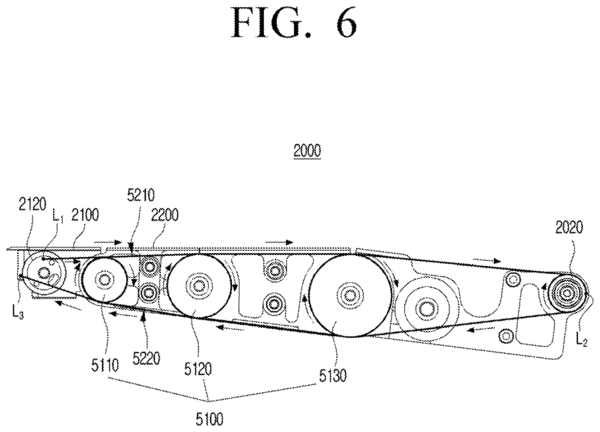
The combination of active pulleys, passive pulleys and springs proposed by Samsung Electronics is intended to improve the mechanical behaviour of the joints.
This approach is part of the robotic manipulation research also being carried out by Tesla, which uses tendon-inspired cable drives, and Boston Dynamics, which is working on joint actuation for its humanoid robots.
Publication US 2026/0326284 A1 remains a patent application, not a granted patent or the announcement of a commercial product. The technology described is a design proposal for future robotic hands, with no launch timeline attached.