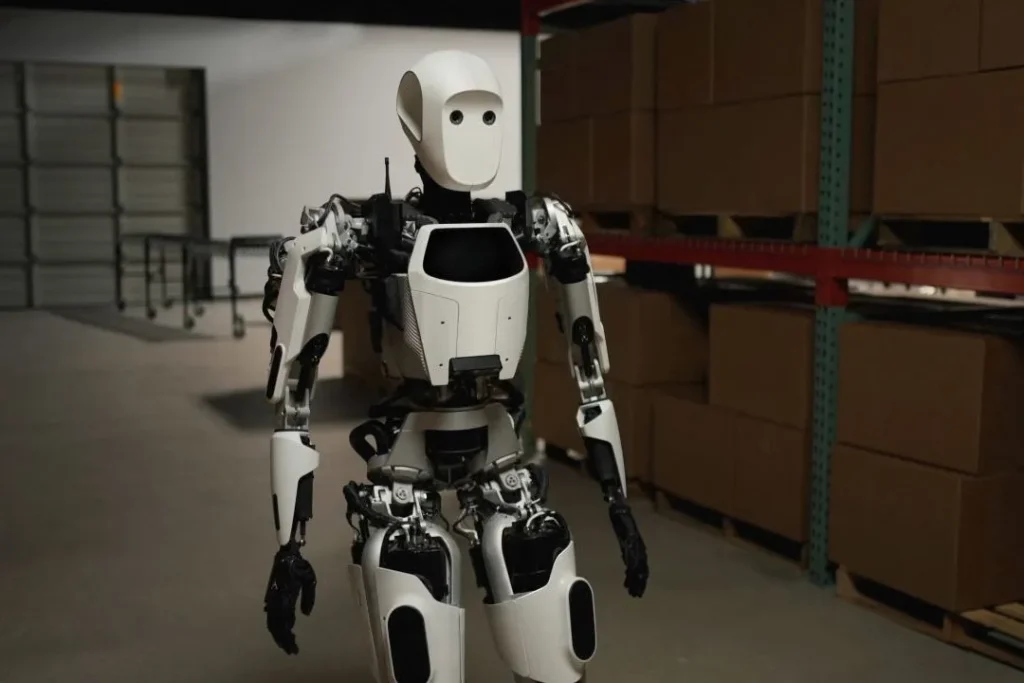
Mimic Robotics has announced FLUX-mimic-x, a 7-billion-parameter robot control model built on FLUX 3. The Swiss company claims a 51.4% success rate on RoboLab-120, a simulated robotic manipulation benchmark developed by NVIDIA.
Zurich-based Mimic Robotics presents FLUX-mimic-x as a model that turns visual information into motor commands in real time. The announcement, posted on X with three slides, concerns a new software architecture for controlling robots. It is not the launch of a physical robot for sale. The published results come from evaluations in simulation.
FLUX-mimic-x: a 7-billion-parameter model built on video generation
The first version was based on NVIDIA’s Cosmos-Predict2, a 2-billion-parameter model. Mimic Robotics then switched to Black Forest Labs’ FLUX 3 with FLUX-mimic, before presenting this new variant, FLUX-mimic-x.
FLUX-mimic-x RoboLab-120 score: a claimed 51.4% success rate
According to Mimic Robotics, FLUX-mimic-x reaches a 51.4% success rate on RoboLab-120 in its version fine-tuned on the DROID dataset. A second configuration presented by the company scores 48.9%.
RoboLab-120 is an NVIDIA benchmark made up of 120 simulated manipulation tasks performed with a Franka robotic arm. Each task is run ten times to evaluate model performance.
Mimic claims the best result among fast “system 1” control models, which convert camera observations directly into motor commands.
The comparisons published by Mimic Robotics include several competing architectures:
- FLUX 3 Action from Black Forest Labs: 42.9% success rate.
- NVIDIA GR00T 2: 47.4% according to Mimic’s chart.
- Runway Praxis-1: 46.2%.
- NVIDIA Cosmos 3 Nano: 36.8%.
- π0.5 from Physical Intelligence: 28.0%.
- NVIDIA GR00T N1.6: 7.2%.
The result claimed for FLUX-mimic-x is therefore 8.5 percentage points higher than that of FLUX 3 Action. Both models share the same FLUX 3 base, but use different adaptations to produce robot actions.
Which systems score higher on the public RoboLab leaderboard
The full public RoboLab leaderboard also includes agentic systems that rely on advanced models.
On this leaderboard, AMP1 reaches an 86.0% success rate and SenseNova-RoboRSI 57.1%. Two other models sit close to the result announced by Mimic: Lakeside, a 5-billion-parameter latent world model, reaches 51.0%, while BiMind v0.5, an 8-billion-parameter VLA fine-tuned on RoboLab data, scores 49.2%.
The FLUX-mimic-x score remains a figure reported by Mimic Robotics: the model does not yet appear on NVIDIA’s public leaderboard. Submissions to the benchmark are temporarily suspended while the procedure is being revised.
How FLUX-mimic-x was trained: robot manipulation data
Mimic Robotics says FLUX-mimic-x used no simulation data during training. The company also states that the model received no data from the robot used in RoboLab, apart from what was already included in the DROID dataset.
This open dataset gathers manipulation demonstrations performed with single-arm Franka robots.
The training mix presented by Mimic also involves several robot configurations. Of all sampled inputs, 36.8% come from two-armed robots fitted with dexterous hands and 21.2% from two-armed robots using grippers.
This variety of configurations is part of the approach the company chose to train its control model.
Industrial use cases already cited for the previous generation
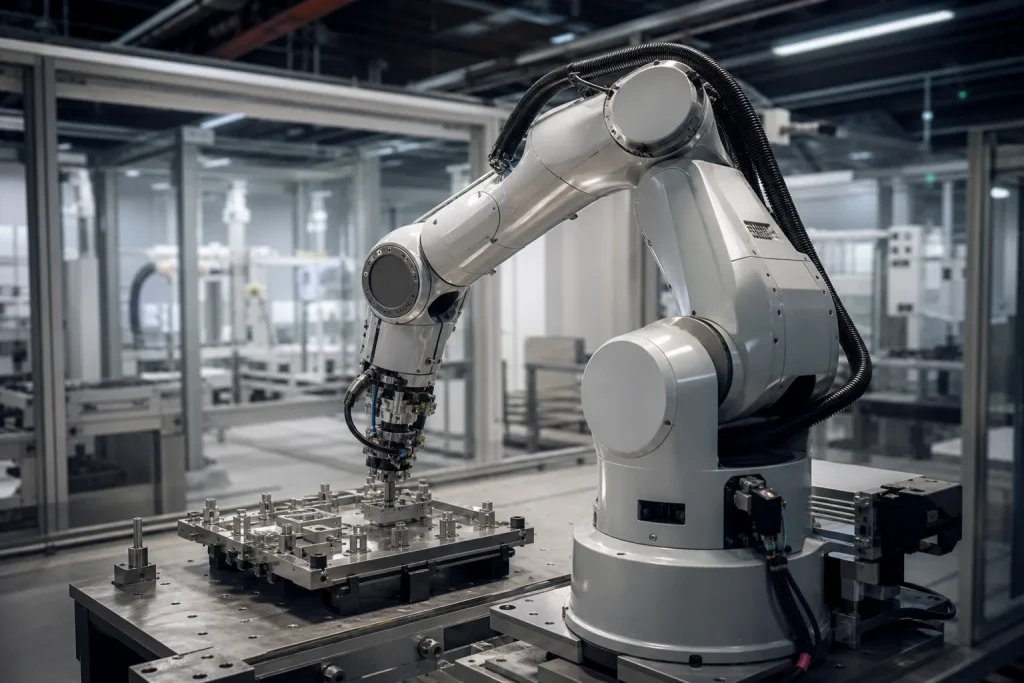
FLUX-mimic-x succeeds FLUX-mimic, an earlier version built on FLUX 3. Black Forest Labs had said that this generation was tested and deployed at Audi for industrial handling operations.
The tasks mentioned included placing parts into trays and inserting electronic control units into holding fixtures.
For this earlier version, Black Forest Labs reported an inference time of under 80 milliseconds on a single NVIDIA RTX 5090 card for the base model, and a reaction time of 101 milliseconds for the complete robotic system.
For FLUX-mimic-x, Mimic Robotics says the model runs on-device and in real time. These characteristics apply to the new version presented by the company, while the industrial trials at Audi concern the previous FLUX-mimic generation.