Rhoda AI is developing a robotics AI trained on large-scale video. Its Direct Video Action (DVA) model, recently extended to mobility, predicts the movements to perform before converting them into commands for robots.
After 18 months of development in stealth, Rhoda AI has gone public with a $450 million Series A funding round. The company works with customers in the automotive, industrial, logistics and e-commerce sectors to deploy its DVA model. Its approach uses video to teach robots how to interact with a wide range of physical environments, rather than relying solely on data collected through teleoperation.
How Rhoda AI uses large-scale video to train robots on physical interactions
Rhoda AI pre-trains its models on videos from the internet so they can learn about movement, physics and how objects interact.
Jagdeep Singh, co-founder and CEO of Rhoda AI, explains that robotics faces a particular difficulty: the data needed to learn physical interactions is harder to gather than the text used to train large language models.
Developers often turn to teleoperation to record robots performing tasks such as folding clothes or making coffee. According to Singh, these lab demonstrations do not guarantee that a robot will work reliably enough in variable real-world conditions.
Rhoda AI aims to get around this limitation by using a much larger volume of visual data. Singh says the model is trained on the equivalent of hundreds of years of video.
How the DVA model predicts a robot’s next actions from video frames
Unlike Vision-Language-Action (VLA) approaches, which combine visual information with text instructions, Rhoda AI uses an architecture called Direct Video Action.
According to Jagdeep Singh, the system analyses a history of video frames, action commands and language information. It then generates a visual prediction of how the scene will evolve over roughly half a second.
This prediction is passed to a second component, called an action converter, which turns the anticipated scene into commands the robot can execute.
The process runs as a repeating cycle:
- The model observes the frames and the available information.
- It predicts how the scene will evolve over the next few hundred milliseconds.
- The converter turns this prediction into robot commands.
- The robot carries out the corresponding movements.
- A new observation updates the prediction and the next actions.
According to Rhoda AI, this loop lets the system regularly adjust its commands as its environment changes.
Mobile DVA: manipulation and mobility in a single robot model
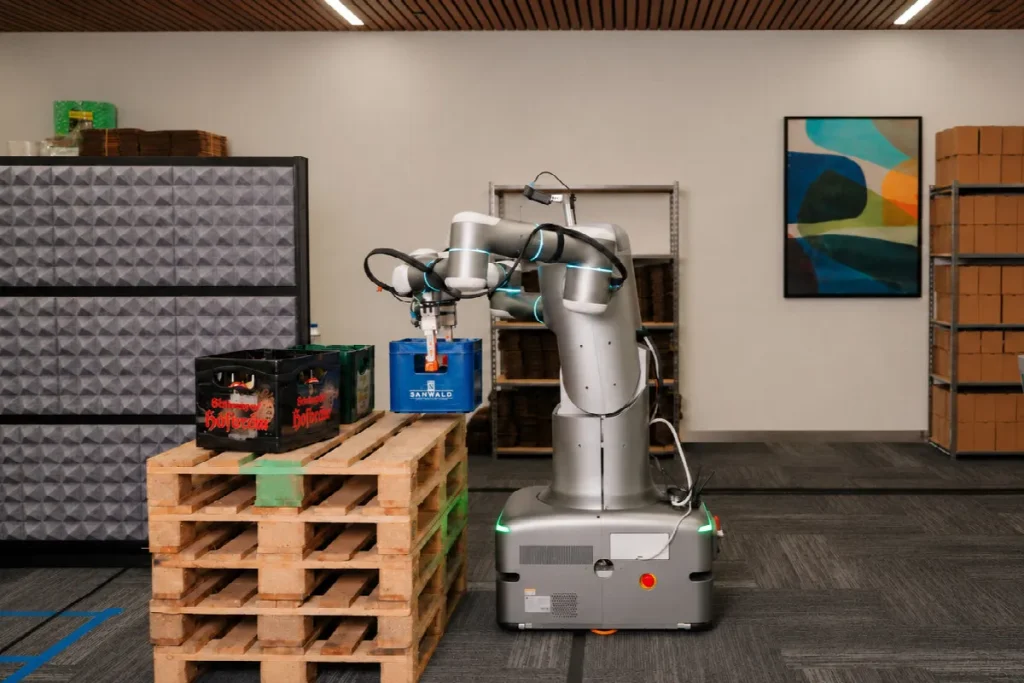
Rhoda AI recently extended its architecture with Mobile DVA. The company says this update brings object manipulation and mobility together within a single robot control policy.
The aim is to handle the robot’s actions on objects and its movements together, rather than treating them as two separate functions.
Rhoda AI presents this combination as a step towards more general-purpose robot models that can work across different setups.
Industrial deployments and the challenge of real-world variability
Rhoda AI works with customers in automotive, industrial manufacturing, logistics and e-commerce to deploy its DVA technology.
Jagdeep Singh points out that every execution of a task and every hardware configuration can be different. In his view, a model trained on too narrow a dataset risks becoming less effective when the situations it encounters drift away from those used during training.
The company is therefore relying on the diversity of its training videos to make its system more robust to variations in the physical world. The generalisation and adaptation capabilities described remain claims made by Rhoda AI as it develops and deploys its technology.