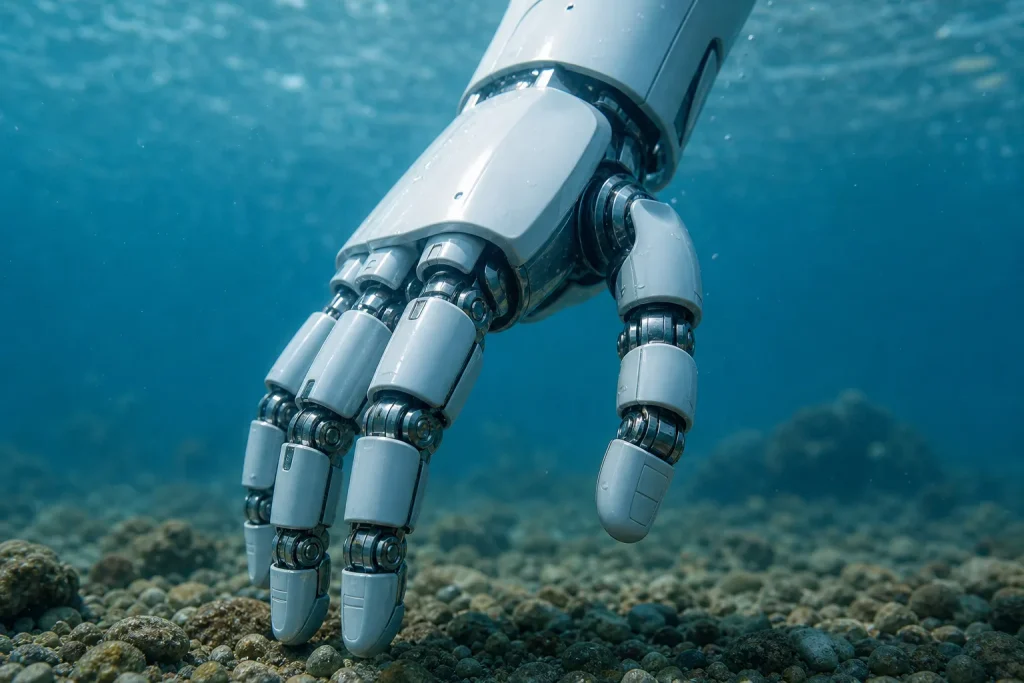
HeymanDex is entering the dexterous robotic hand market with a focus on water resistance. The company is developing two sealing solutions for different depths, covering uses from household tasks to underwater operations.
In the humanoid robot industry, makers of dexterous hands mostly work on increasing degrees of freedom, grip force and precision of movement. HeymanDex is taking a different route: it builds protection against harsh environments into its robotic hands from the design stage, rather than treating it as an add-on feature.
How underwater robotics shaped HeymanDex’s approach
HeymanDex’s positioning draws on its team’s experience with specialised underwater equipment. According to the company, its engineers have worked on underwater platforms able to operate in the 8,000-metre depth class, and on sampling equipment developed for the Jiaolong crewed submersible.
This work exposed the team to the pressure, corrosion and sealing constraints of underwater operations. HeymanDex now aims to apply that expertise to articulated robotic hands.
The approach targets several categories of applications: household tasks involving water, such as washing vegetables or dishes, industrial processes that use cutting fluids or lubricants, and technical work in underwater environments.
Two sealing systems for different depths: 0 to 1,000 m and 1,000 to 10,000 m
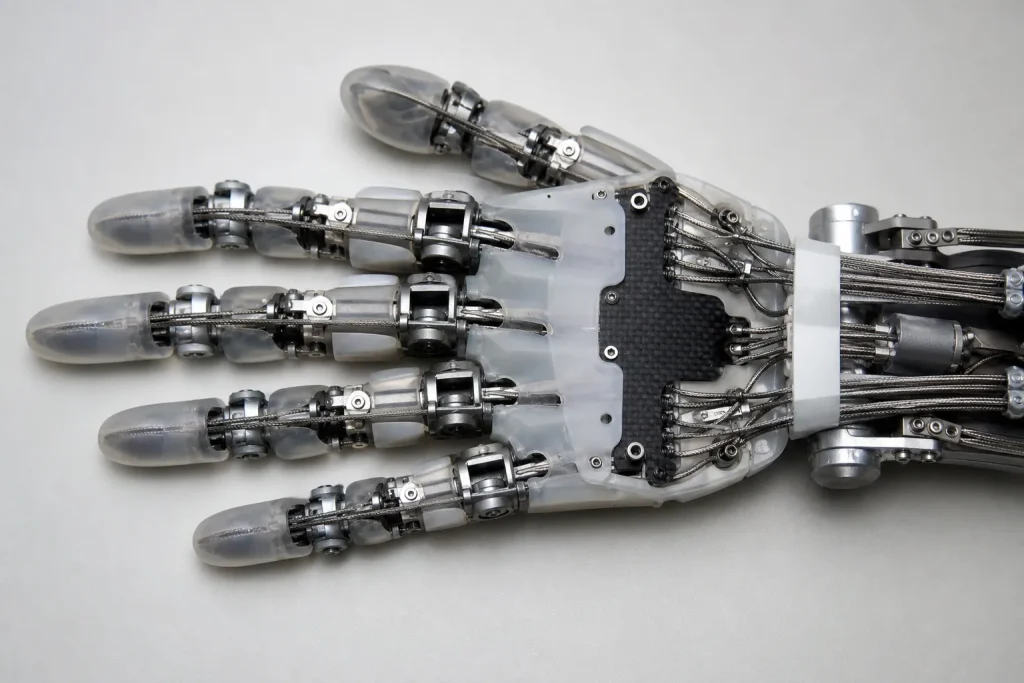
The main technical challenge lies in the finger joints. A robotic hand has to perform repeated bending and stretching movements while protecting its internal mechanisms. The seal therefore has to remain effective on moving parts without compromising how motion is transmitted.
HeymanDex presents its integrated underwater dynamic sealing system, developed in-house, as a core part of its technology. The company separates its solutions into two sets according to operating depth:
- From 0 to 1,000 metres deep: high linear speed axial dynamic sealing, high-reliability radial static sealing and magnetic coupling dynamic sealing.
- From 1,000 to 10,000 metres deep: dynamic hydraulic pressure compensation, oil-filled magnetic coupling dynamic pressure balancing and two-stage static sealing.
These ranges correspond to the depths targeted by the technologies HeymanDex presents, not to robotic hand performance validated in underwater tests.
Joint protection as a way to stand out from other robotic hand makers
In a market where competition centres largely on finger mobility, strength and response speed, HeymanDex aims to set itself apart through its systems’ ability to withstand environmental stress.
This approach extends the target applications beyond controlled land-based environments. For industrial uses, it covers in particular handling tasks carried out in contact with liquids that could reach the mechanisms of robotic hands.
Developing the technology also relies on optimising materials, manufacturing processes and overall product design. HeymanDex’s technical goal is to keep the joints flexible while protecting them in wet and underwater environments.