XPENG is highlighting GroundingPI, a visual perception model with around 4 billion parameters. In simulation tests, the technology improves how robots learn manipulation tasks, notably with fewer training demonstrations.
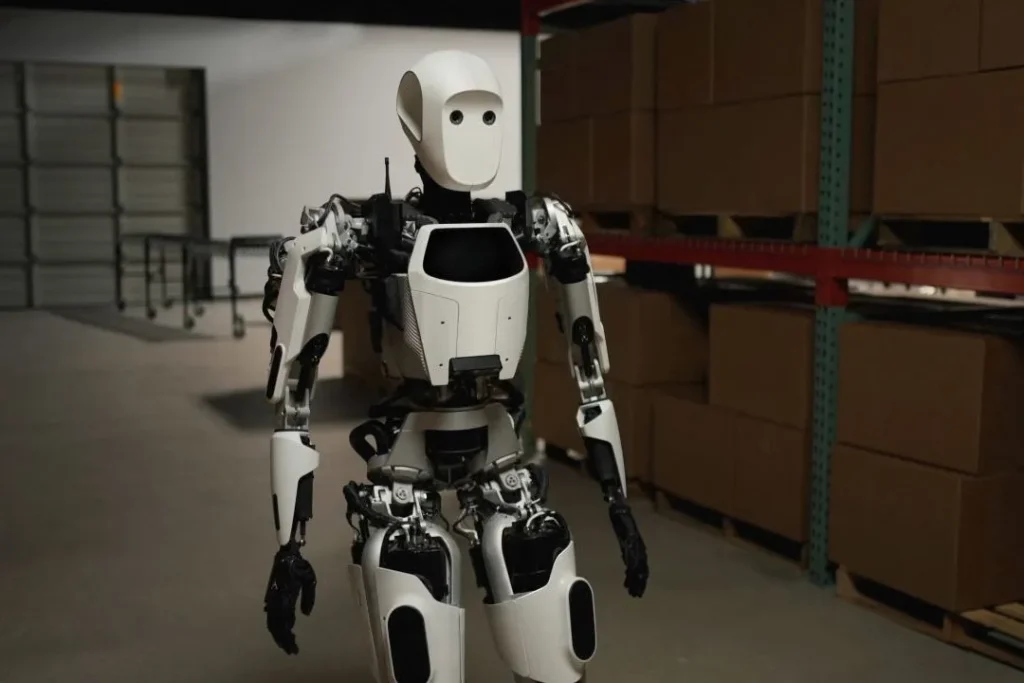
In an announcement published on 4 November, XPENG presented research carried out with Peking University, the University of Hong Kong and other academic institutions. GroundingPI is designed to let artificial intelligence systems precisely locate objects and their individual parts. It is an open research project, not an announcement of integration into the IRON humanoid robot or a commercial launch.
How GroundingPI locates objects and their parts to guide robot actions
GroundingPI is based on a visual perception approach that represents positions in an image using points and bounding boxes. The system can therefore identify a specific part of an object, such as the handle of a mug, and pass its position to another system responsible for carrying out an action.
According to the researchers, the model uses a shared coordinate vocabulary across several tasks: object detection, text recognition, interface understanding and spatial perception.
This approach produces information that a robot control system can use directly, rather than stopping at a text description of the environment.
GroundingPI benchmark results: 34 visual perception tests
The researchers evaluated GroundingPI on 34 benchmarks spread across 11 capability categories. According to their results, the model achieves an aggregate score of 73.68, compared with 71.54 for GPT-6 Astra.

This ranking gives equal weight to each category and covers only the capabilities assessed in this set of perception tests. It is not a general comparison of reasoning or artificial intelligence performance.
The researchers also identified persistent difficulties in some tasks involving the localisation of small objects and text recognition.
Humanoid robot manipulation with fewer training demonstrations
The robotics experiments are GroundingPI’s main point of interest for humanoid robot developers. The researchers paired several pre-trained visual perception models with the same action control architecture to compare their effect on learning.
For each baseline, the action training data, the optimisation budget and the other parameters of the robot policy were kept constant.
The evaluations covered two simulation environments:
- RoboTwin 2.0: manipulation tasks with two robotic arms mounted on a fixed base.
- RoboCasa-GR1: humanoid manipulation tasks using hands capable of precise movements.
In RoboCasa-GR1, according to the researchers, GroundingPI keeps its advantage with only half of the available demonstrations, while the models it was compared with use three quarters of them.
The project also reports improvements on four RoboTwin tests carried out under conditions different from those encountered during training.
These results suggest that more precise visual perception can make learning robot movements more efficient in simulation.
Is GroundingPI coming to the IRON humanoid robot?
GroundingPI has one important characteristic: its visual perception training does not rely on data describing robot actions. The control systems that use this perception, however, still learn from robot demonstrations.

The experiments therefore do not show a robot able to learn a new physical task without action data. Handling movements, contact with objects and corrections during execution remains the job of the associated control system.
The results concern simulated environments, not a manipulation demonstration on a physical humanoid robot. XPENG’s announcement does not mean GroundingPI is being commercialised or deployed in IRON.
GroundingPI paper, model weights and code released before XPENG’s announcement
The scientific paper on GroundingPI was published on 30 September. The model weights and code were then released in early October as part of the open research project.
The 4 November announcement therefore puts the spotlight on a technology that was already public, with experimental results that mainly concern visual perception and learning robotic manipulation in simulation.