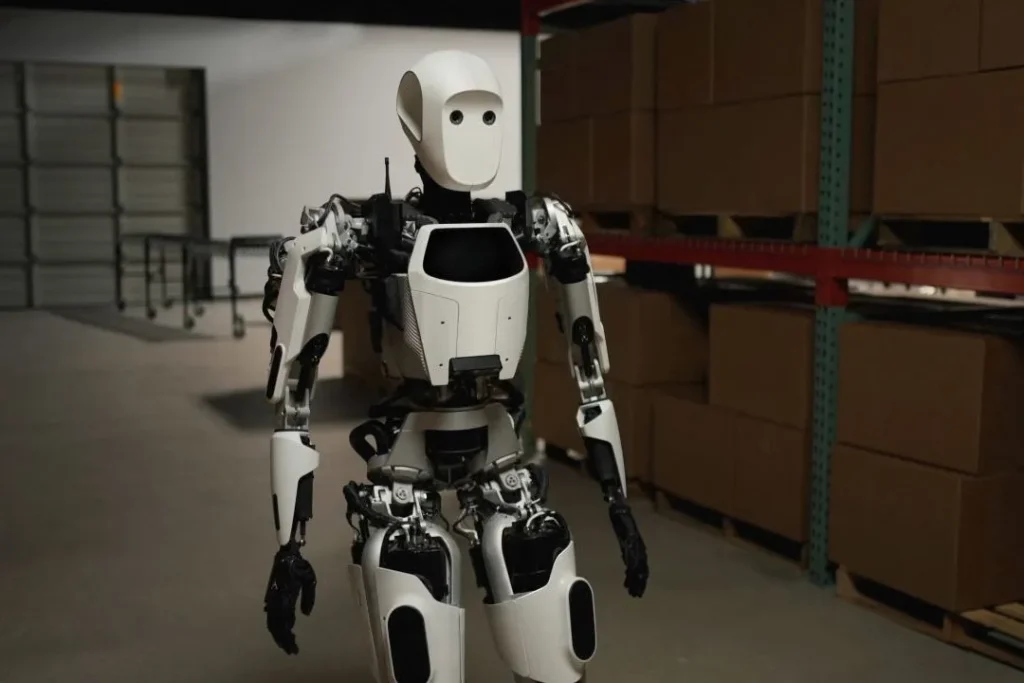
GXO Logistics and Apptronik have signed an agreement to prepare the global deployment of up to 1,000 Apollo humanoid robots over four years. The first installations are planned for late 2027 in North America, provided the trials deliver satisfactory results.
Logistics provider GXO Logistics is expanding its partnership with US humanoid robot maker Apptronik. The agreement extends Apollo trials in operating warehouses ahead of a possible large-scale rollout. The two companies are considering a Robotics-as-a-Service (RaaS) business model, under which the robots would be used as part of a service offering.
Global rollout depends on trial results
GXO and Apptronik are targeting up to 1,000 Apollo humanoid robots worldwide over a four-year period. This is a conditional target, not a firm order for that volume.
The first deployments are planned for North America at the end of 2027. Whether they go ahead will depend on how the robots perform in trials and on meeting productivity, safety and operational metrics agreed between the partners.
The planned commercial framework is based on the RaaS model. It is meant to let GXO gradually increase the number of robots in use through a flexible, service-based offering.
Patrick Kelleher, CEO of GXO, describes the collaboration as an extension of the group’s experience in logistics automation. The company intends to identify the applications where humanoids can deliver the greatest operational benefits to its customers and its teams.
Warehouse trials: order picking, tote handling, packing and sorting
From 2027, GXO and Apptronik plan to expand their joint trials of the Apollo robot in operating logistics facilities. Several operations will be evaluated:

- Goods-to-person order picking, where goods are brought to the operators.
- Person-to-goods order picking, where operators move to the goods.
- Moving cartons and logistics totes.
- Packing products.
- Sorting goods.
Each application will be assessed against jointly defined productivity, safety and operational metrics. The trials must also validate the technical and safety requirements needed for large-scale use.
In particular, the partners will look at how Apollo can work alongside GXO employees and the automation systems already in place in the warehouses.
Partnership since 2024, with more than 50 logistics tasks tested
The collaboration between GXO and Apptronik began in 2024 with a proof-of-concept programme focused on practical applications of the Apollo humanoid robot in a warehouse environment.
In 2026, Apollo completed a pilot programme at a GXO facility in the United States. The trial covered the autonomous picking of small consumer goods, an application the partners consider successful.
The two companies also carried out real-world data collection and autonomous evaluations on more than 50 different logistics tasks at Apptronik’s Robot Park, a facility used to train humanoid robots.
Jeff Cardenas, CEO and co-founder of Apptronik, explains that the partnership aims to measure humanoids against the operational metrics of logistics facilities. He highlights the role of GXO’s network with a view to large-scale use.
What Apollo is designed for: repetitive, physically demanding warehouse work
Apptronik designs Apollo to carry out repetitive and physically demanding operations in warehouses. GXO and Apptronik want to use the technology in particular to address labour availability issues and to improve throughput and the operational uptime of their facilities.

The companies also plan to shift part of their employees’ work towards higher-value activities by assigning certain handling operations to the humanoids.
The next step in the partnership will be to test these applications against the operational requirements of GXO’s warehouses, in order to determine which ones can be gradually rolled out across its international network.