On 9 November 2026, NXP Semiconductors presented a robotics development platform that combines artificial intelligence, sensors and real-time control. It is aimed at drones first and is due to expand to other categories of robots in 2027.
The semiconductor maker wants to simplify the design of autonomous machines through a common architecture, a modular, open-source software development kit (SDK) and pre-validated hardware reference designs. The goal is to let developers build up the functions of a robotic system step by step, without having to integrate each hardware and software component separately.
NXP says a first drone function can be running in 30 minutes
The platform is built on the Neural-Axis architecture, which is designed to link a robot’s various computing and control units. It coordinates AI processing, sensor data, communication and operations that require deterministic real-time control.
According to NXP, developers can bring up a first drone function in 30 minutes using the reference designs and the robotics SDK. This is a bring-up target announced by the manufacturer, not the time needed to develop a complete autonomous drone.
Development can start with a single function, such as motor control, before adding AI-based perception, flight control and navigation.
NXP believes that pre-integrated software and pre-verified interfaces could cut some integration and validation work, which previously sometimes took several months, down to a few days or weeks.
Four reference designs for building drone functions
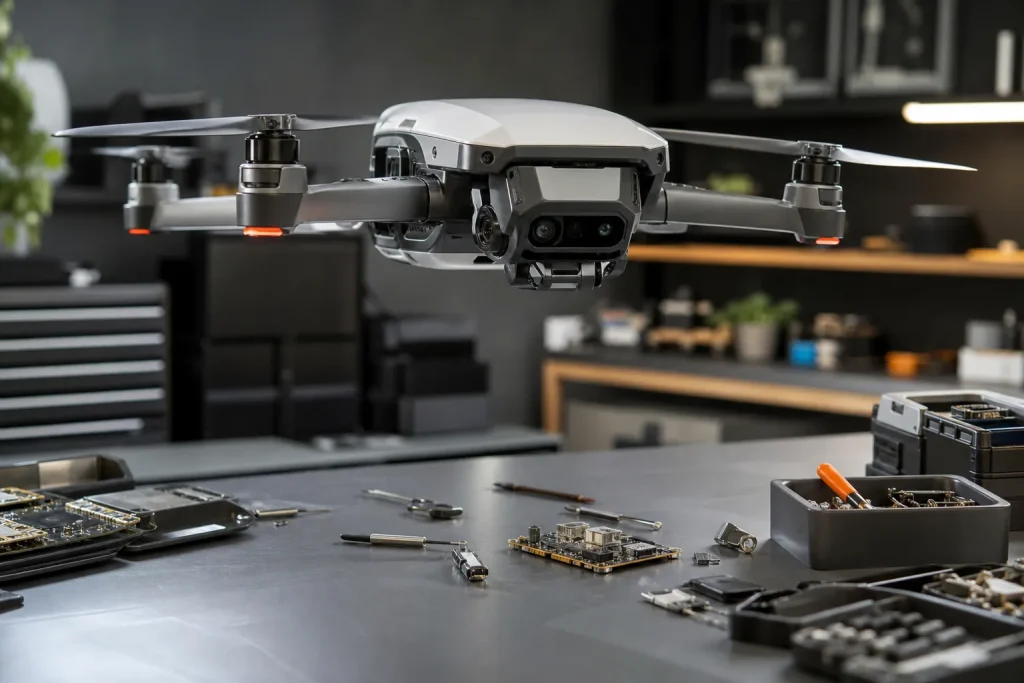
For the commercial launch of its platform, NXP is focusing on unmanned aerial systems. The manufacturer presents four hardware reference designs, each intended for a specific technical function.
- NavQ95: based on the i.MX 95 application processor, it handles autonomous data processing and flight control.
- Tropic VMU/FMU: fitted with the i.MX RT1064 crossover microcontroller, this module is intended for flight management.
- 100Base-T1 Sensor Node: built on the MCX N947 microcontroller, it provides intelligent sensor networking.
- AM32-compatible electronic speed controller: based on the MCX A13 microcontroller, it is dedicated to motor control.
These components can be combined using the robotics SDK. This modular approach lets developers select the subsystems an application needs, then integrate them into a common architecture.
An open-source robotics SDK compatible with ROS 2, PX4 and Zephyr
NXP’s SDK is designed to work with frameworks already used in robotics development. It notably integrates ROS 2, PX4 and Zephyr, to make it easier to use existing software tools.
The kit includes supported drivers, middleware integrations, reference applications, configuration tools and reusable software components.
The Neural-Axis architecture also addresses functional safety and cybersecurity. According to NXP, the security features built into the various processors and microcontrollers can be enabled independently of the robotics-specific functions.
This separation lets developers work on robotic functions while keeping the option to enable the security mechanisms provided in the hardware components.
Service robots and autonomous mobile robots planned for 2027
Drones are the first commercial application NXP is targeting, but the manufacturer plans to extend its platform to other robotic systems in 2027.
Future reference designs are expected to cover service robots and autonomous mobile robots (AMRs) in particular, as well as other machines that combine several automated functions.
These developments will target applications that combine environmental perception, navigation, motor control, communication between subsystems and secure real-time operations. The Neural-Axis architecture is intended to serve as a common foundation for these different categories of machines.