In China’s Yunnan province, a first technical standard now governs the experimental use of apple-harvesting robots. Presented at an official ceremony, the framework comes with trial contracts and a demonstration of robotic picking in an orchard.
Yunnan province is taking a further step in testing agricultural robots. According to the Chinese newspaper Kunming Daily, a ceremony held on the 11th was used to present a technical regulation covering the experimental use of apple-harvesting robots. Agricultural companies also signed contracts to test the machines under real operating conditions.
How the apple-picking robot harvests fruit in the orchard
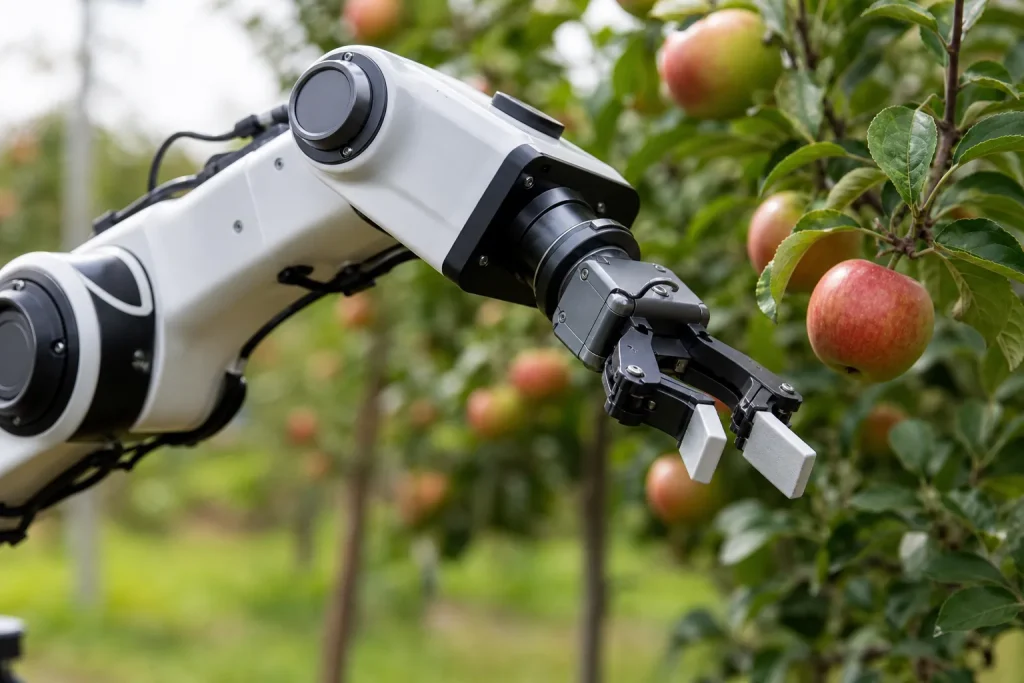
During the event, a blue and white agricultural robot carried out a harvesting demonstration in an orchard. Fitted with a camera and a robotic arm, it moved along the rows of trees to locate apples and pick them.
The camera identified the position of the fruit. The robotic arm then gripped each apple gently, twisted it to detach it and placed it in a basket.
The demonstration also showed how the robot handled apples growing between branches. The system worked around obstacles while handling the fruit to avoid damaging the trees.
These operations were shown as part of a public demonstration, ahead of an experimental phase governed by the new standard.
A tablet app to start the harvest
The robot’s operation was also presented through a control app on a tablet, named Guoduocai in the Chinese text.
A representative of one of the participating agricultural companies showed how to start operations from the interface. Once the start command was activated, the robot began moving through the orchard autonomously.
The app was presented as a tool meant to make the robot easier to use and to let growers follow its operation visually during harvesting.
What Yunnan’s first apple-harvesting robot standard covers
The regulation presented in Yunnan is the province’s first enterprise standard dedicated specifically to the experimental use of apple-harvesting robots.
It sets out a technical framework covering several areas:
- The technical parameters of harvesting robots.
- The operational performance expected during use.
- The standardisation of equipment and orchard layouts.
- The tree shape characteristics suited to robotic harvesting.
The aim is to move from prototype testing to trials organised around common requirements. This approach is meant to make it easier to evaluate the machines in farming environments prepared for their use.
At the ceremony, several companies, including Nongxin Technology, signed contracts for the experimental use of apple-harvesting robots. These agreements cover a supervised trial phase, not an announced commercial launch to the general public.
Sunlight and tree shape remain technical challenges
After the demonstration, participants discussed the conditions needed to deploy the robots in orchards. Variations in light, particularly changes in sunlight and shadows cast by foliage, were among the difficulties identified.
These conditions can complicate visual recognition of the fruit. Participants stressed the need for long-term validation to address the problems encountered in real orchards.
Discussions also covered adapting plantations to the machines. Proposals included using dwarfing rootstocks, high-density planting and standardising tree shape.
These changes are intended to concentrate the apples at a height suited to mechanised operations, making them easier for robotic arms to reach during harvesting.