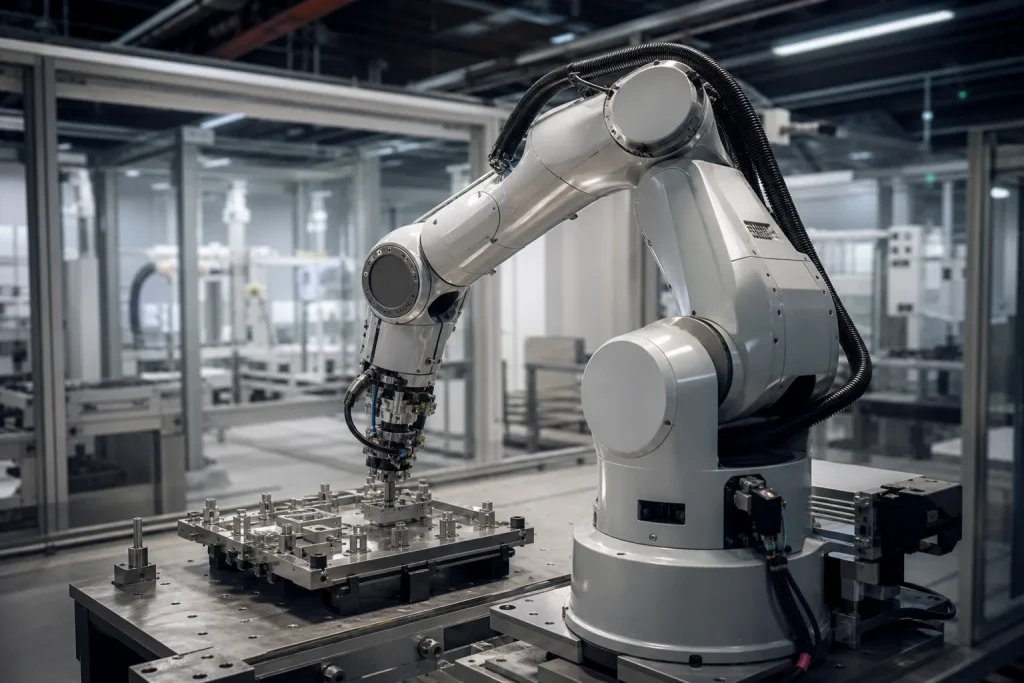
Anthropic reports a result of 64.9% for Claude Fable 5.2 on RoboDojo, a simulated robotics benchmark. The company also presents robots handling objects and carrying out drawing tasks with its new artificial intelligence model.
With Claude Fable 5.2, Anthropic is emphasising its model’s ability to control robots from visual information. The announcement came on the same day NVIDIA presented GR00T 2 at the CoRL conference in Austin. Both companies are positioning robot control as one of the applications of their AI systems.
Claude Fable 5.2 robot demos: three manipulation tasks on physical robots
The footage shows three separate tasks:
- Solving a puzzle cube by manipulating its faces.
- Unscrewing a bottle cap.
- Drawing a picture of a robot.
Anthropic says Fable 5.2 has significantly better physical robot control capabilities than previous versions of Claude. The company points in particular to robotic tasks the model was not explicitly trained on.
These clips are physical demonstrations, separate from the simulation results. They show the operations carried out by the robots presented, but do not establish a reproducible success rate for each of these manipulations.
What RoboDojo measures: camera-based control of a two-arm robot
The result reported by Anthropic comes from RoboDojo Sim, an evaluation environment in which an AI controls a simulated two-arm robot using camera images.
RoboDojo was published in July by a group of more than 40 researchers from institutions including HKU MMLab, UC Berkeley, Tsinghua, Peking University, Stanford and MIT. It includes 42 simulated tasks on a two-arm ARX X5 robot setup, reproduced in NVIDIA Isaac Sim.
The evaluations cover five categories: generalisation, precision, long-horizon tasks, memory and open-ended tasks. The robot receives images from a camera mounted on its head and from two wrist cameras.
Each control policy is evaluated 50 times per task and per random seed. The leaderboard separates the full success rate from an average score that also awards points for partially completed tasks.
RoboDojo also has a physical component made up of 18 additional tasks performed on three types of robotic arm.
Claude Fable 5.2 vs GPT-6 Astra on RoboDojo, according to Anthropic
According to Anthropic’s internal evaluations, Claude Fable 5.2 reaches 64.9% on RoboDojo Sim, compared with 29.8% for OpenAI’s GPT-6 Astra. These results were obtained in the same evaluation environment, using the highest effort settings available for each model.
Anthropic also says Fable 5.2 outperforms most AI systems designed specifically to control robots.
Comparing this with the public RoboDojo leaderboard, however, requires distinguishing between two metrics: the average score and the full success rate. Anthropic does not specify which of these the 64.9% figure refers to, which limits direct comparison with the leaderboard results.
RoboDojo leaderboard: robotic agents hold the top spots
In the RoboDojo leaderboard updated on 3 November, robotic policies trained to control machines are ranked separately from systems designated as agents.
Among the ranked policies, X Square Robot’s WALL-OSS-1.0-lite comes first with an average score of 42.59 and a success rate of 34.97%. RobotEra’s VPP2 follows with a score of 39.26 and a success rate of 32.26%.
The agents post higher results. Qoo Tech’s Q0-Preview reaches a score of 74.20 and a success rate of 68.87%. AGIBOT’s GO-3 Nano Preview scores 61.90 and 56.42% respectively, while PKU DAGroup’s PyRUA-Lean reaches 55.26 and 50.35%.
Whether Fable 5.2’s result is read as an average score or as a success rate, it would sit behind Q0-Preview and ahead of the ranked robotic policies in both cases. This position is only an indicative comparison, because Anthropic’s result comes from its own internal evaluations.
The public RoboDojo leaderboard is run by a non-profit organisation. The researchers behind the benchmark say no commercial company is involved in managing it.