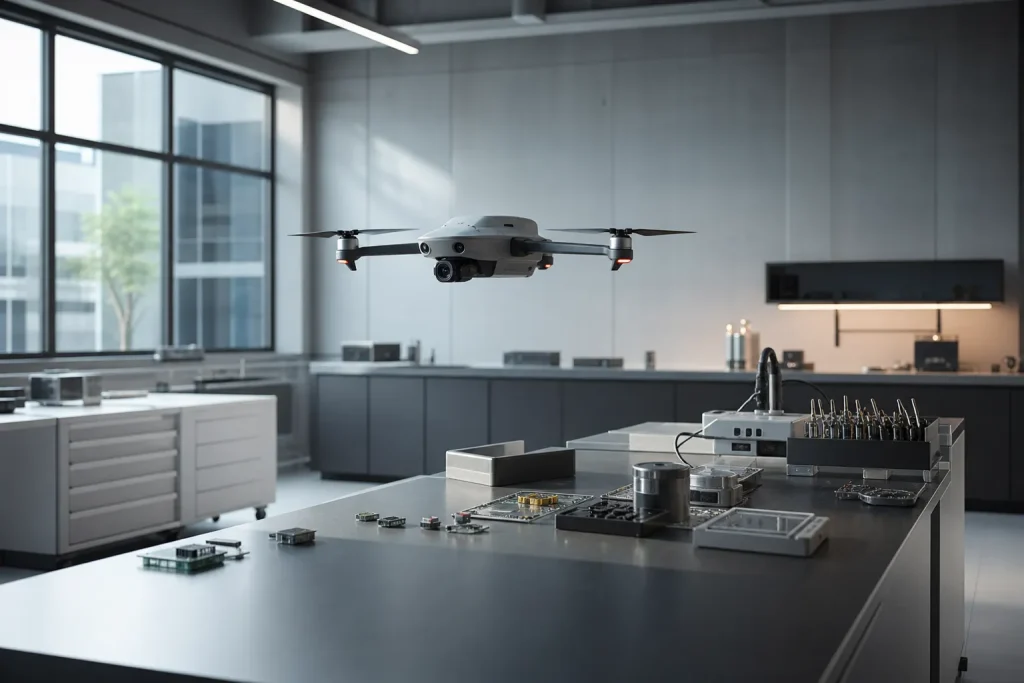
NXP Semiconductors has announced a unified robotics platform designed to simplify the design of drones and autonomous robots. Built on its Neural Axis Architecture, it combines pre-integrated software, reference hardware and development tools.
The Dutch semiconductor company announced on the 9th that it is developing the unified robotics platform. Its aim is to reduce the work needed to assemble and validate the different components of a robotic system. The solution targets drone makers first, with an extension planned to service robots and autonomous mobile robots (AMRs).
Neural Axis Architecture: one framework for sensors, AI and robot control
The platform is based on Neural Axis Architecture, an architecture developed by NXP to link a robot’s main functions: sensing its environment, real-time control, artificial intelligence processing and communications.
According to NXP, this approach connects these functions securely while building in cybersecurity and functional safety mechanisms. The goal is to make it easier to design reliable robotic systems, particularly for applications that use physical AI.
The solution pairs an open software development kit (SDK) with reference hardware designs. Its modular architecture, based on open-source components, includes:
- Supported software drivers and middleware to connect the different subsystems.
- Reference applications and reusable software components.
- Configuration tools for developers.
- Integration with the PX4, Zephyr and ROS 2 open-source environments.
Development teams can work on individual robotic functions, then gradually combine them in a shared environment to build more complex autonomous systems.
How much development time NXP says it saves
One of NXP’s main arguments concerns shorter integration times. According to the manufacturer, assembling and validating several robotic subsystems previously took up to several months of work.
With its pre-integrated software and validated interoperability between components, NXP says it can reduce some development phases to a few days or a few weeks. This is a time saving claimed by the manufacturer, not an independently measured result.
The approach is aimed in particular at companies that need to update their prototypes regularly, add new artificial intelligence functions or adapt their machines to different uses.
Drone makers first: how the platform is used to build a drone
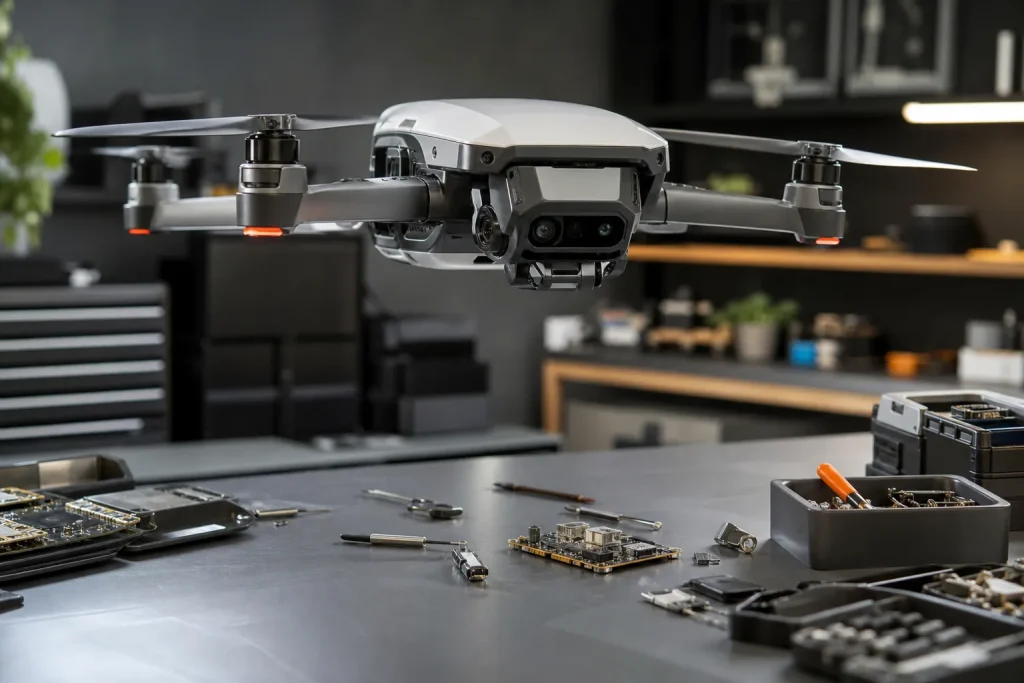
NXP plans to deploy its technology first in drone development. A manufacturer could, for example, start by evaluating motor control, then gradually add AI-based perception, flight control and navigation.
This method is meant to let developers test each function before integrating it into a complete autonomous drone, without rebuilding the whole software environment at every stage.
James McClearen, chief technology officer of blueflite, stresses the importance of short development cycles in a sector where customer needs and autonomous functions change quickly. In his view, the NXP platform can speed up the evaluation of new ideas, the building of prototypes and their conversion into commercial products.
Service robots and AMRs: NXP’s planned extension
After drones, NXP plans to extend its platform to other categories of machines, notably service robots and autonomous mobile robots (AMRs). These could use the same modular approach to integrate their perception, navigation, communication and control functions.
Jerome Legros, vice president and general manager of NXP’s robotics division, places particular emphasis on the reliability of autonomous systems. He describes cybersecurity, functional safety, real-time control and reliability across the entire lifecycle as necessary foundations for the development of physical AI.
The announcement concerns a hardware and software development platform, not a new robot for sale. NXP plans to start with aerial applications before extending the architecture to ground-based robotic systems.