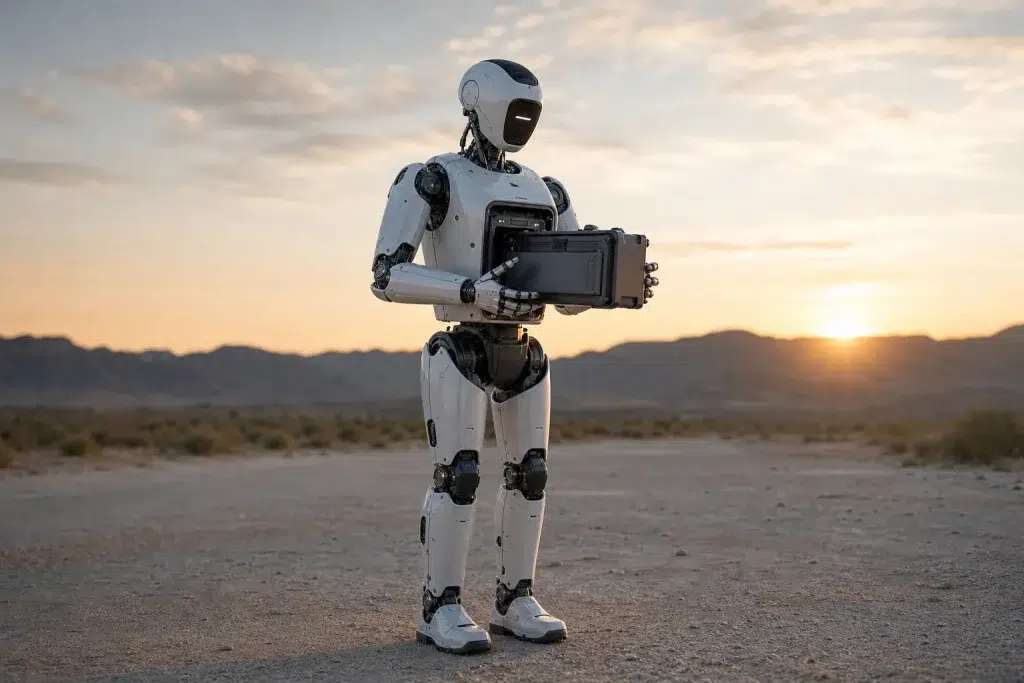
Hitch Open has announced the worldwide opening of its open source physical intelligence platform. At its launch in China, a robot table tennis demonstration reached 142 exchanges, with a research team from Shanghai.
Hitch Open comes from Silicon Valley, California, and grew out of academic work at the University of California, Berkeley. It presented its platform at a conference held in the Lingang exhibition area of the China International Import Expo. The initiative aims to bring together players in artificial intelligence and robotics around competitions held in real physical environments.
Hitch Open: an open source platform for robotics research
Hitch Open presents itself as a global competition platform for physical intelligence, designed to test artificial intelligence systems on tasks carried out in the real world.
Its approach relies on demanding challenges, designed to advance the perception, decision-making and action capabilities of robotic systems in complex environments.
The platform targets several technology fields, including autonomous driving, embodied intelligence and robotics. Opening it as open source is meant to support research and the development of these technologies through experimental competitions.
142 exchanges: the record claimed with a Shanghai research team
At the launch conference, Hitch Open held a table tennis challenge involving robots equipped with AI-based autonomous decision-making systems.
A team from Shanghai Jiao Tong University and the Shanghai Institute of Intelligent Innovation, working with Hitch Open, reached 142 exchanges in this challenge. The organisers describe the result as a new world record in this category of robot competition.
The demonstration shows how physical competitions can be used to assess a robot’s perception, decision-making and motion control capabilities together.
Why table tennis is a test bed for physical AI in robots
Table tennis places specific demands on robotic systems. The speed of the ball and changes in its spin require continuous analysis of its trajectory and fast adjustment of movements.
According to information presented at the launch, the robots’ reaction window is on the order of a hundred milliseconds in this challenge. This time frame covers the processing of the information needed to respond to the ball’s movements.
The robots therefore have to link perception of their environment, decision-making and execution of movements in a real-time control loop.
Each additional exchange tests perception accuracy, decision speed and the quality of motor control at the same time. Hitch Open uses this challenge to test these different capabilities within a single physical situation.