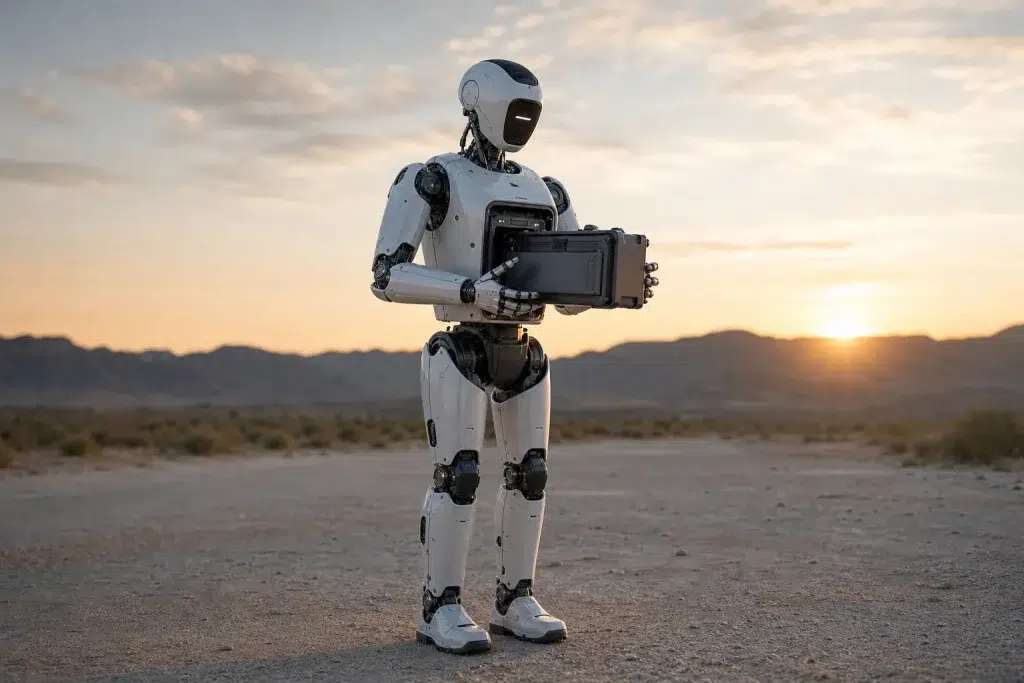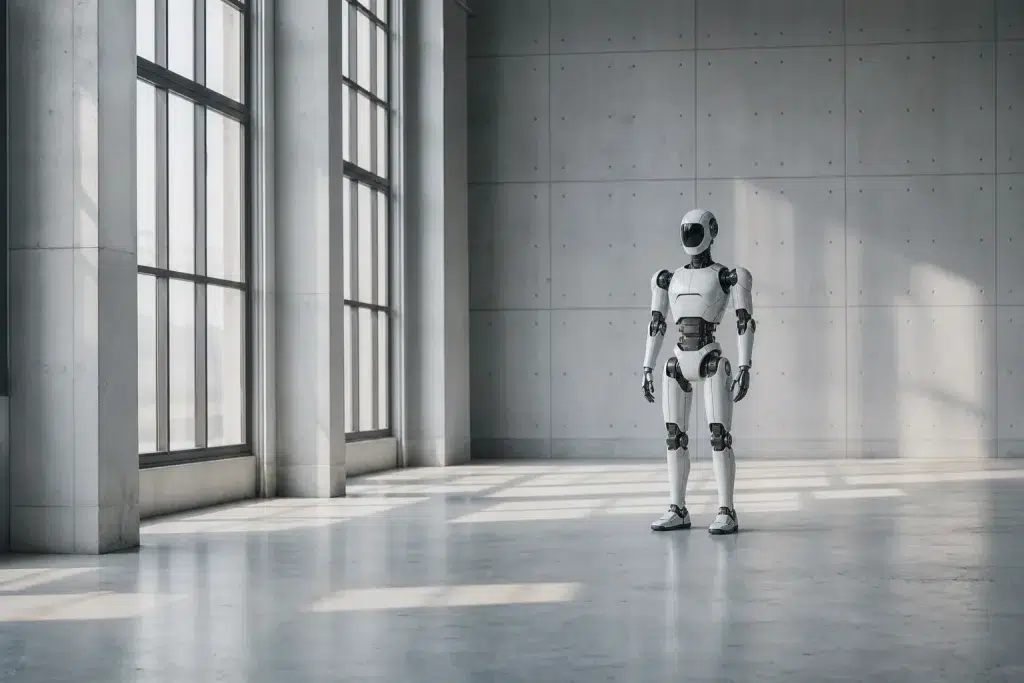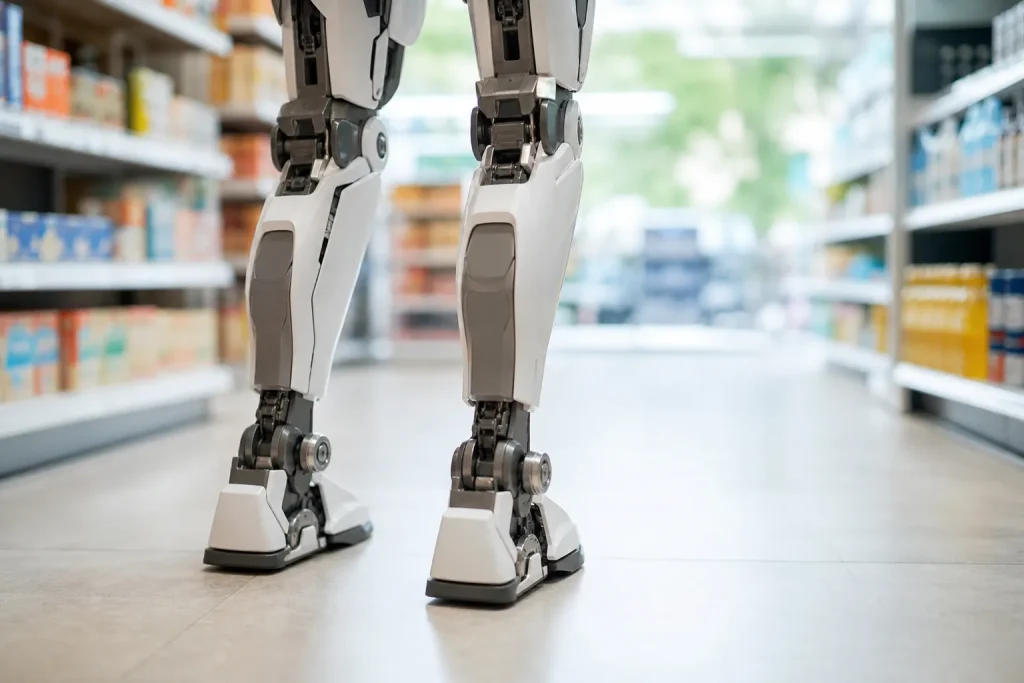
RobotWorld 2026 brings together several new humanoid and mobile robots. A-Robot is showing ALICE M2 for the first time, while T-Robotics introduces TR-WORKS, a two-armed mobile robot designed for industrial production.
South Korean companies A-Robot, T-Robotics, Samhyun, Gaon Robotics and Safeway are using RobotWorld 2026 to present their work in physical AI. The announced demonstrations cover industrial manipulation as well as residential delivery, waste collection and mobility over difficult terrain.
A-Robot ALICE M2: a new humanoid robot designed for more flexible tasks
ALICE M2 makes its first public appearance at RobotWorld 2026. Developed by A-Robot, the humanoid builds on the technologies used in ALICE M1, with announced improvements in mobility and in flexibility when carrying out tasks.
A-Robot develops its own high-torque-density linear actuators. Their design is inspired by the human muscular system: a motor drives a ball screw that converts rotation into linear motion, which linkage mechanisms then transmit to the joints.
This architecture does away with a separate gear reducer between the motor and the ball screw. According to A-Robot, it reduces mechanical backlash and improves the accuracy of position and force control. The company also uses impedance control to absorb external impacts and regulate the forces the robot applies.
Two other platforms accompany ALICE M2 at the show:
- ALICE5: a bipedal humanoid that won the Best Custom Humanoid award at RoboCup 2026. A-Robot intends it mainly for physical AI research and complex tasks.
- ALICE M1: a platform already tested in industrial settings, including automotive parts plants and cosmetics manufacturing.
With ALICE M2, A-Robot continues to build a range of general-purpose humanoids intended for a variety of work environments.
T-Robotics TR-WORKS: a two-armed mobile robot for industrial logistics
T-Robotics presents TR-WORKS, a mobile humanoid with 20 degrees of freedom, a height of 180 cm and a payload of 3 kg, according to the specifications provided by the manufacturer.
Unlike bipedal humanoids, TR-WORKS uses an autonomous mobile base of the AMR type. T-Robotics is thus prioritising precise movement in industrial environments, particularly for intralogistics operations.
The robot has an articulated upper structure with movement at the waist, knees and torso. A vertical lift and torso-tilt mechanism lets it adjust its position during manipulation tasks.
The manufacturer is targeting cleanrooms in the semiconductor and display industries, as well as precision logistics operations. TR-WORKS can be connected to an existing fleet management system so that it works alongside other robots in the same factory.
T-Robotics is also exhibiting 3 stationary two-armed humanoid models, designed for tasks specific to industrial processes. The company presents this combination of stationary and mobile robots as a solution for automating production sites.
Samhyun demonstrates its AXLON actuators for humanoid robots
Manufacturer Samhyun is devoting part of its presence at RobotWorld 2026 to the components that allow humanoids to generate and control their movements.
Its AXLON actuator range is being demonstrated lifting heavy loads and holding position. Another demonstration focuses on bidirectional teleoperation, with real-time motion tracking and force feedback.
Visitors can also see the internal structure of the actuators and a robot with an upper body built on these components. Samhyun’s aim is to show how drive mechanisms, control and the movements actually performed are linked.
The company is also presenting BOLDUM, its new range of high-payload autonomous mobile robots, intended mainly for logistics automation.
Samhyun is also exhibiting HOPLON, a common platform for robots and unmanned vehicles based on an open architecture, as well as a quadruped robot shown being assembled and started up.
Gaon Robotics uses Hyundai’s MobED platform for delivery and waste collection
Gaon Robotics presents a daily-living assistance solution that combines Hyundai Motor Group’s MobED mobile platform with its own application modules.
Two operating scenarios are planned for the demonstrations. The first covers the delivery of parcels, drinks, food and everyday items to a set location. Once the supervision system has received and checked the request, the robot travels autonomously to its destination, where the user collects the items.
The second scenario covers sorted waste collection in residential complexes. The robot picks up recyclable waste left outside homes and carries it automatically to a designated collection point.
Gaon Robotics aims to show a complete service chain, from receiving a request to physically carrying out the task. The demonstrations illustrate possible applications in apartment complexes and shared living spaces.
Safeway Ascender: wheels that let robots climb curbs and stairs
Safeway is tackling the obstacles that restrict mobile robots, particularly curbs, stairs and rough terrain.
The manufacturer presents Ascender, a motorised wheel that uses an elastic tyre to climb over changes in level without tracks or complex joints. The technology is intended for autonomous robots, as well as smart wheelchairs and AI-equipped pushchairs.
A second version, Ascender Zero, works without a motor, sensor or battery. It climbs obstacles through the deformation of the tyre and a mechanical clutch. Safeway plans for it to be fitted by replacing the existing wheels on various equipment, including trolleys, pushchairs and hand trucks.
Safeway is also presenting SENTINEX, an autonomous robot developed with the Korea Expressway Corporation for motorway work zones.
An operator inside a vehicle can send it out to place warning signs. When the work is finished, the robot collects the signs and returns to recharge. It can also report road surface damage, such as potholes, to the supervision centre.
Safeway is also conducting joint research with the Institute for Automotive Engineering at RWTH Aachen University in Germany on a modular robotic platform based on physical AI.